AI Native Isn't a Feature. It's a Decision to Build Everything You Depend On.

Most companies calling themselves "AI native" are not. They are AI-powered, maybe. AI-enabled, sure. But native? That word means something specific, and most people are skipping past it.
Being AI native is not about which tools you use or how many LLM APIs you've wired together. It is a foundational decision about how you build the company itself. And the single biggest mistake I see founders make is treating their internal stack, their CRM, their customer support system, their analytics, their email, their comms, as something to buy rather than something to own.
That one decision shapes everything that comes after it.
The Buy-First Trap
I get why founders default to buying. You are moving fast, you need to ship, and every SaaS tool promises a clean integration and a support team on standby. So you plug in Intercom, Customer.io, Google Analytics, a contract tool, a referral platform, and suddenly your product is running on ten different third-party systems that each own a slice of your data and your workflow.
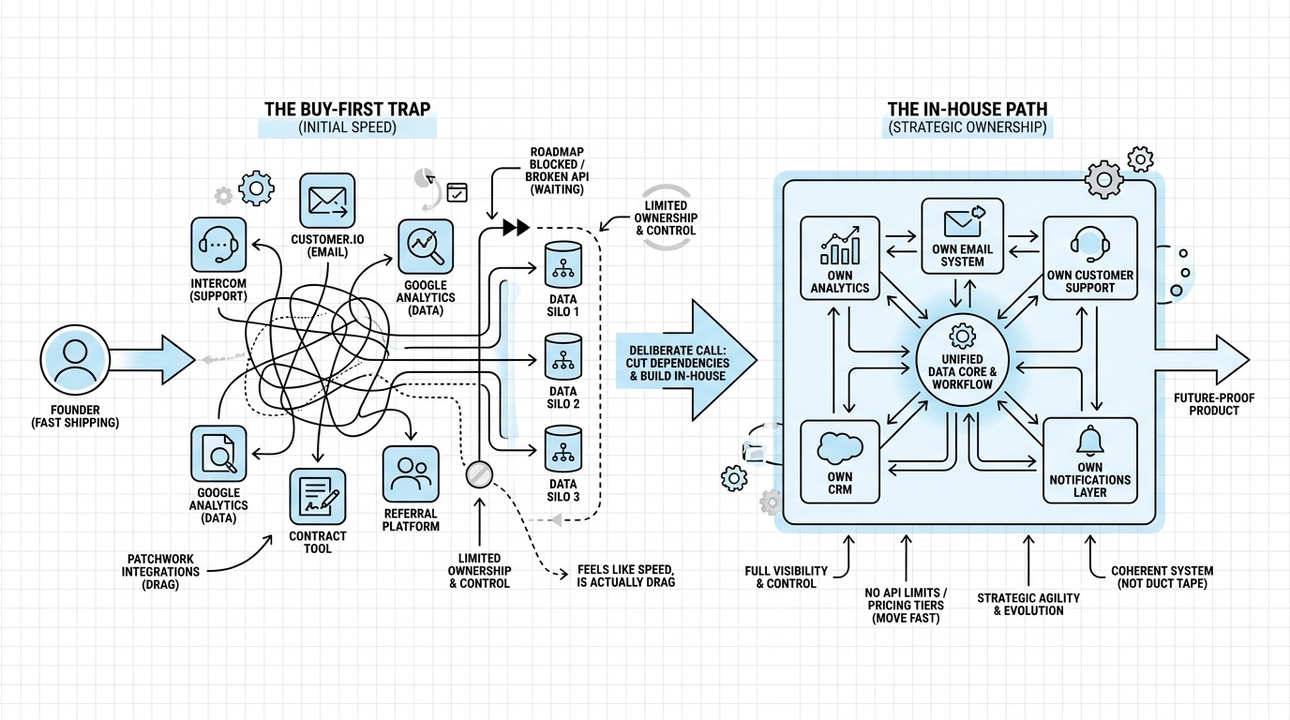
It feels like speed. It is actually drag.
We lived this at Bono. In the early days, we were stacking integrations like everyone told us to. And for a while it worked, right up until it did not. As the product evolved and the use cases got more specific, we started hitting walls everywhere. We needed to pull data through those third-party sources, pass it along to something else, and none of it was under our control. When something broke, we were waiting on their support teams. When we needed a custom behavior, we were blocked by someone else's product roadmap.
The moment you need your systems to talk to each other in ways the vendors never anticipated, you realize how little of your product you actually own.
When Bono made its pivot into content marketing and Voice AI, we made a deliberate call: cut the third-party dependencies and build in-house. Not because we had unlimited time or an enormous team, but because we could see clearly that the path forward required full ownership. So we built our own analytics system, our own email system, our own customer support mechanism, our own CRM, our own notifications layer. What users see on the surface is one thing. What sits behind it is a fully integrated stack that we control entirely.
The difference is not just operational. It is strategic. We have visibility into everything that happens in the product. Data cross-pollinates naturally across the system. We can move fast because nothing is gated by an external vendor's API limits or pricing tier. And the product can evolve as a single coherent system rather than a patchwork of integrations held together with duct tape.
What AI Native Actually Requires
Here is the philosophy I keep coming back to: if you are building an AI native company from the ground up, you should be prepared to invest in the LLM layer and the core infrastructure beneath it. That is where external dependency makes sense, because those are genuinely hard problems at a scale that most product teams cannot replicate.
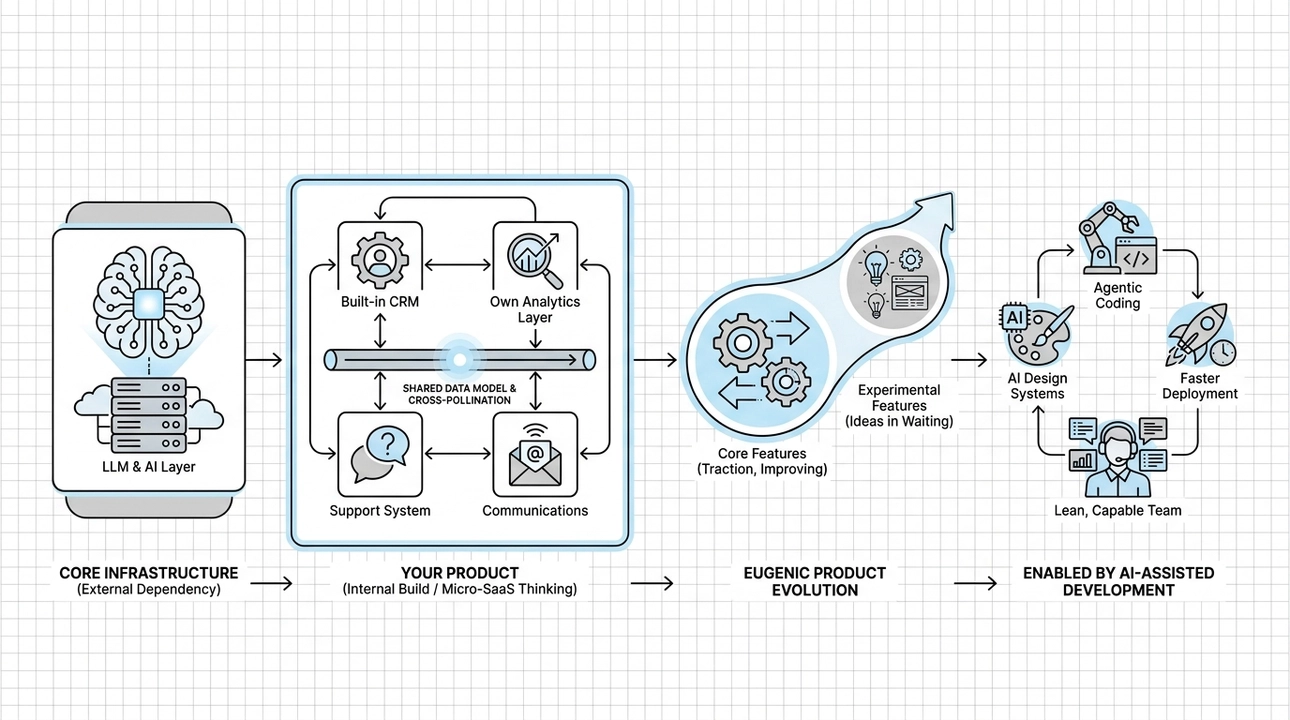
But everything beyond that layer, every business function, every internal tool, every customer-facing system, should be something you are building inside your own product. That is what I mean by micro-SaaS thinking applied internally. You are not buying a CRM, you are building your own lightweight CRM that lives inside your product and knows everything your product knows. You are not buying an analytics platform, you are building your own tracking layer that feeds directly into how you make decisions.
This approach gives you something that no SaaS subscription ever will: cross-pollination. When your customer support data, your usage analytics, your communications, and your CRM all live in the same system, built on the same data model, the insights you can surface become genuinely different. You start building what I would call a eugenic product, one that evolves with the business because every layer feeds every other layer.
There will always be two categories of features in what you build: core features and experimental ones. Not everything you ship will get heavy usage. Some things will sit there quietly as ideas in waiting. That is fine. The goal is to keep building for every real need that surfaces, and to keep improving the things that gain traction. The system grows with you rather than constraining you.
The shift in AI-assisted development has made all of this far more accessible than it was even two years ago. Agentic coding tools, AI-assisted design systems, faster deployment pipelines, these have fundamentally changed the economics of building. What used to require a much larger team and a much longer runway can now be done with a lean, technically capable team that is thorough, mindful, and moving with intention. You have to be present for what you are building and clear on how you want to build it, but the tools available now make the build path genuinely viable in a way it never was before.
Build for a Year, or Build for a Decade
I know what the pushback sounds like. "I do not have the time for this." "My team is not big enough." "I need to move now and figure the rest out later."
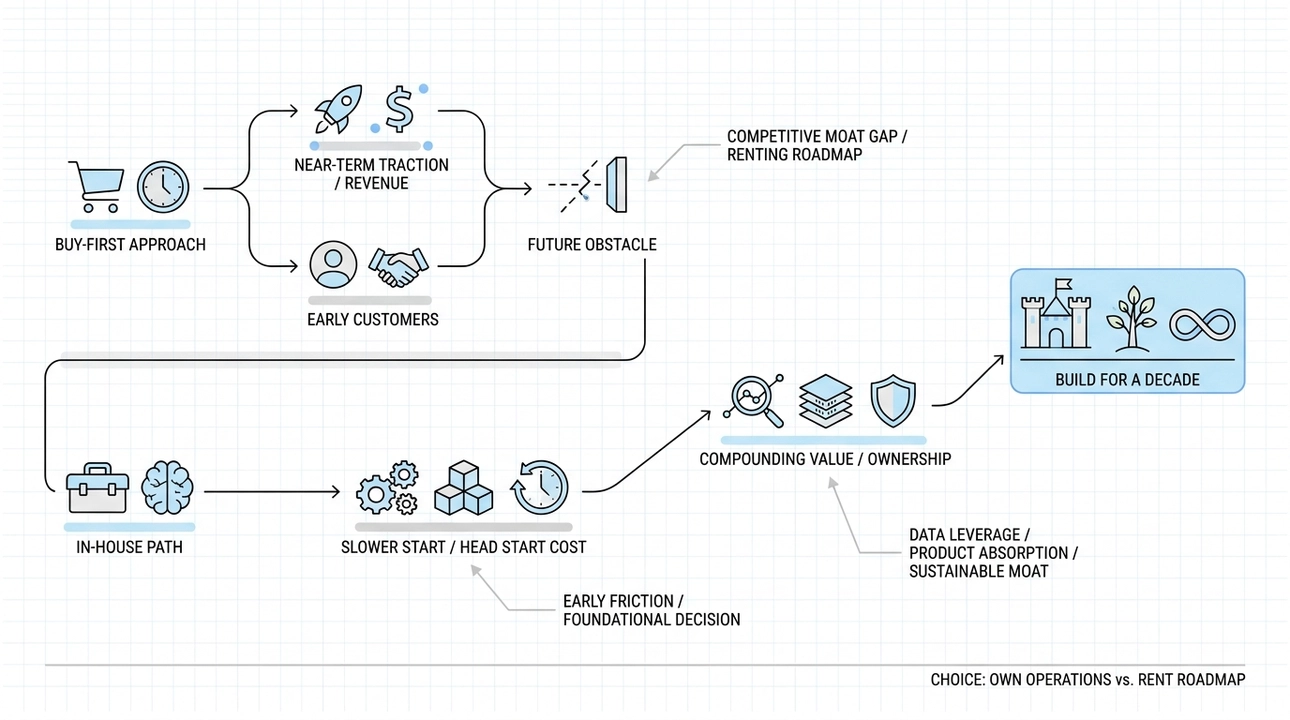
I hear that. And honestly? If you are not ready to do this yet, that is okay. You can still get traction in the near term with the buy-first approach. You will probably get revenue. You will probably get some early customers.
But here is what I would ask you to sit with: right now, there are companies building AI native from the ground up. They are going through the same early friction you are trying to avoid. In two or three years, those companies are going to have a competitive moat that is very hard to close. Not because they were smarter or better funded, but because they made a foundational decision early and compounded on it.
You are not just choosing between a faster start today and a harder start today. You are choosing between building something for a year and building something for a decade.
The in-house path is slower to start. There is a real head start cost. I am not going to pretend otherwise. But once you are through it, the business operates at a different level. You have leverage that SaaS subscriptions cannot give you. You have data that competitors on bought stacks cannot access. You have a product that can absorb every new AI capability without renegotiating with a vendor or waiting for an integration to ship.
Start rethinking it now, even if you implement it gradually. The founders who treat distribution, operations, and tooling as things to own rather than rent are the ones building something that lasts. Everything else is just getting a head start on someone else's roadmap.