Beginning the Year With Intention: Balancing Pace, Presence, and People

Happy New Year!
The start of a year is a small but meaningful pause for me. I do not treat it as a magical reset or a cure for bad habits. Instead, it is a moment to slow down, look honestly at how life feels, and decide what deserves more care in the year ahead.
I have learned that change does not require a specific date. A birthday, a quiet weekend, the end of a demanding stretch, or the start of spring can all serve the same purpose. What matters is choosing a window of time where intention replaces drift.
Over the past several years, through growth, uncertainty, and a few humbling resets, I have settled into a simple planning rhythm that helps me stay grounded while still moving toward long-term aspirations. I share it here not as a system to copy, but as a way of thinking you can adapt to your own life and season.
Why I still use the New Year as a checkpoint
I am someone who benefits from natural pauses. The New Year creates one without needing justification. Conversations slow down, expectations reset, and there is social permission to reflect.
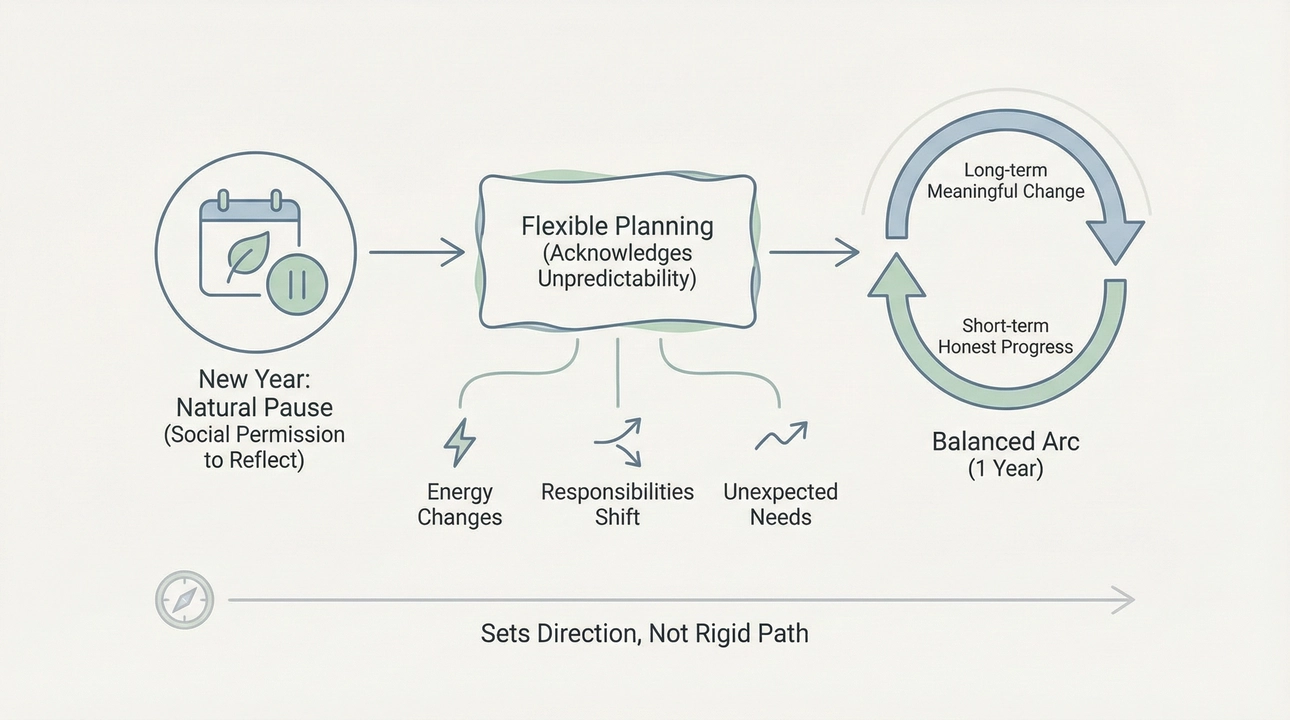
I also know that life rarely cooperates with neat plans. Energy changes. Responsibilities shift. People we care about need us in unexpected ways. Because of that, my New Year planning is intentionally flexible. It sets direction without pretending I control the path.
I think in long arcs, but I live in shorter ones. A year is long enough to create meaningful change and short enough to stay honest about progress. That balance keeps me from both overreaching and coasting.
The three areas I return to
To keep perspective, I look at life through three lenses: personal, professional, and community. This is less about achieving balance and more about maintaining awareness. These areas are not separate in practice. When one quietly erodes, it eventually shows up everywhere else, often before I consciously notice it.
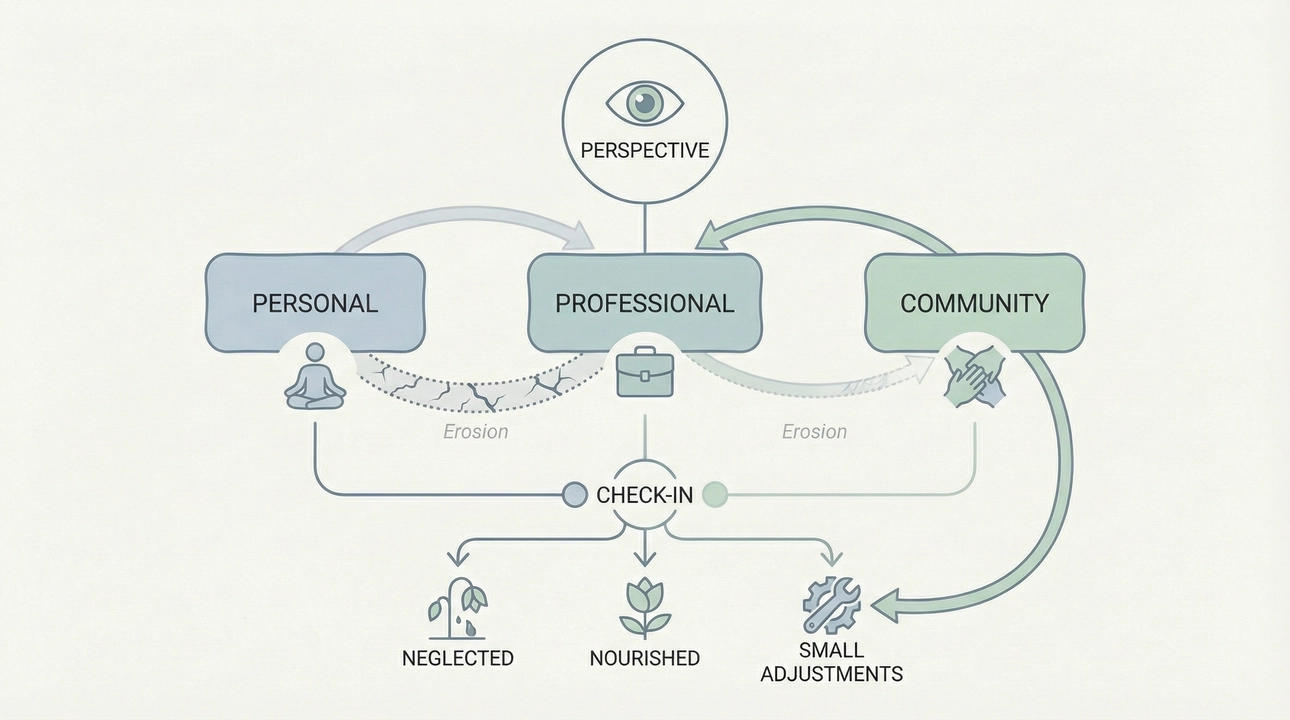
Returning to these three areas gives me a simple way to check in with myself. Not to judge or optimize, but to notice what has been neglected, what feels nourished, and where small adjustments might restore alignment.
1. Personal
Personal goals are about how I feel in my body, how present I am with the people I love, and whether I am creating space for things that restore rather than drain me.
This is the category I protect most deliberately, precisely because it is the easiest to postpone. When life gets busy or demanding, personal care is often framed as optional. I have learned the hard way that when I am tired, disconnected, or ignoring my own health, no amount of progress elsewhere feels grounding for long.
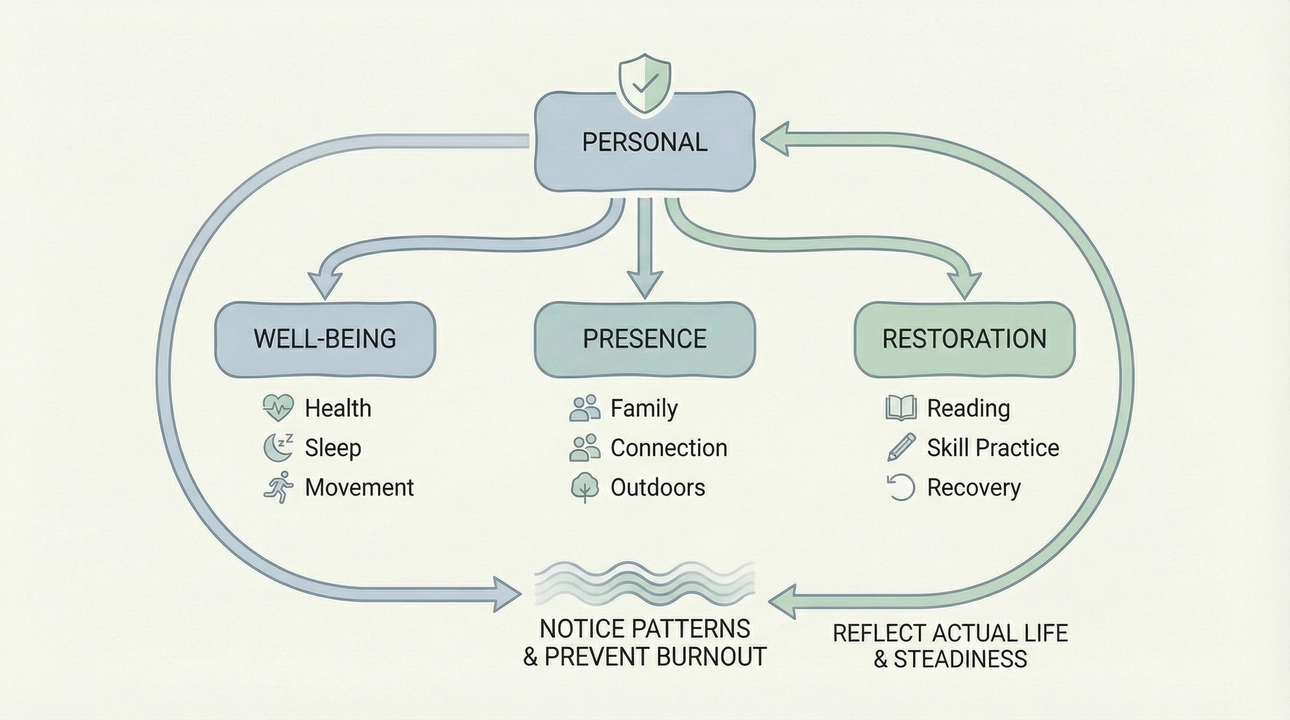
I do use simple measures here, but gently. Time spent with family, quality sleep, consistent movement, time outdoors, reading without rushing, or steady practice of a skill I care about. These numbers are not about self-improvement or discipline. They help me notice patterns and surface quiet warnings before they turn into burnout or resentment.
Some years are about growth and expansion. Other years are about recovery, steadiness, or simply staying well. I try to let these goals reflect the life I am actually living, not the one I imagine on a perfectly controlled calendar.
2. Professional
My professional goals are about direction rather than constant acceleration, even though the two can sometimes look similar from the outside.
I genuinely enjoy what I do. Because of that, it has always been difficult for me to see work as something separate from life. The pace, the speed, and the momentum energize me. They drive innovation, learning, and a sense of forward motion that I find deeply motivating.
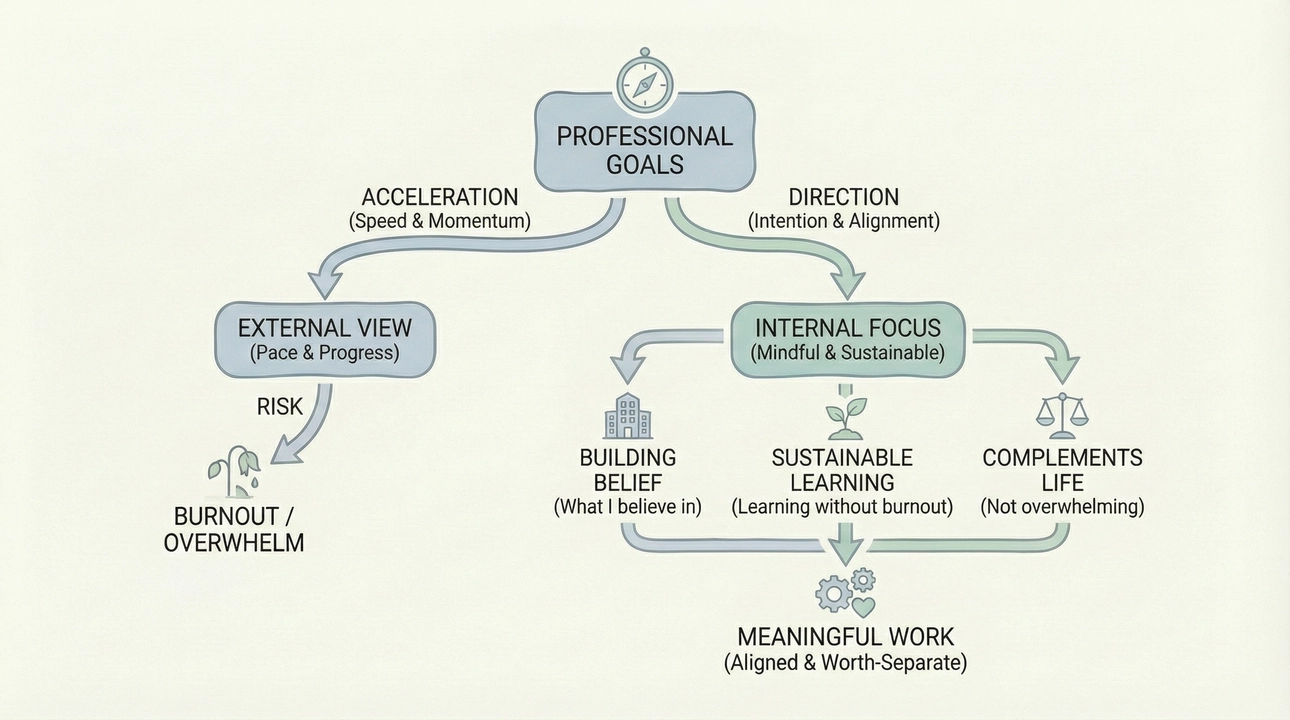
At the same time, enjoyment does not remove the need for intention. I try to stay mindful about how work fits into my life rather than letting it define it entirely. The question I return to is not whether I am moving fast, but whether the direction still feels aligned and sustainable.
I write these goals down to stay honest with myself. Am I building things I believe in? Am I learning without burning out? Am I choosing work that complements the rest of my life rather than quietly overwhelming it?
Work matters to me, and I take it seriously, but I resist turning progress into a measure of personal worth. Liking the pace does not mean ignoring the cost.
3. Community
Community goals exist to remind me that life is shared.
This includes friendships I want to be more intentional about, people I want to support without an agenda, and communities and networks I care about showing up for consistently rather than occasionally. Relationships, like anything else, benefit from attention and honesty over time.
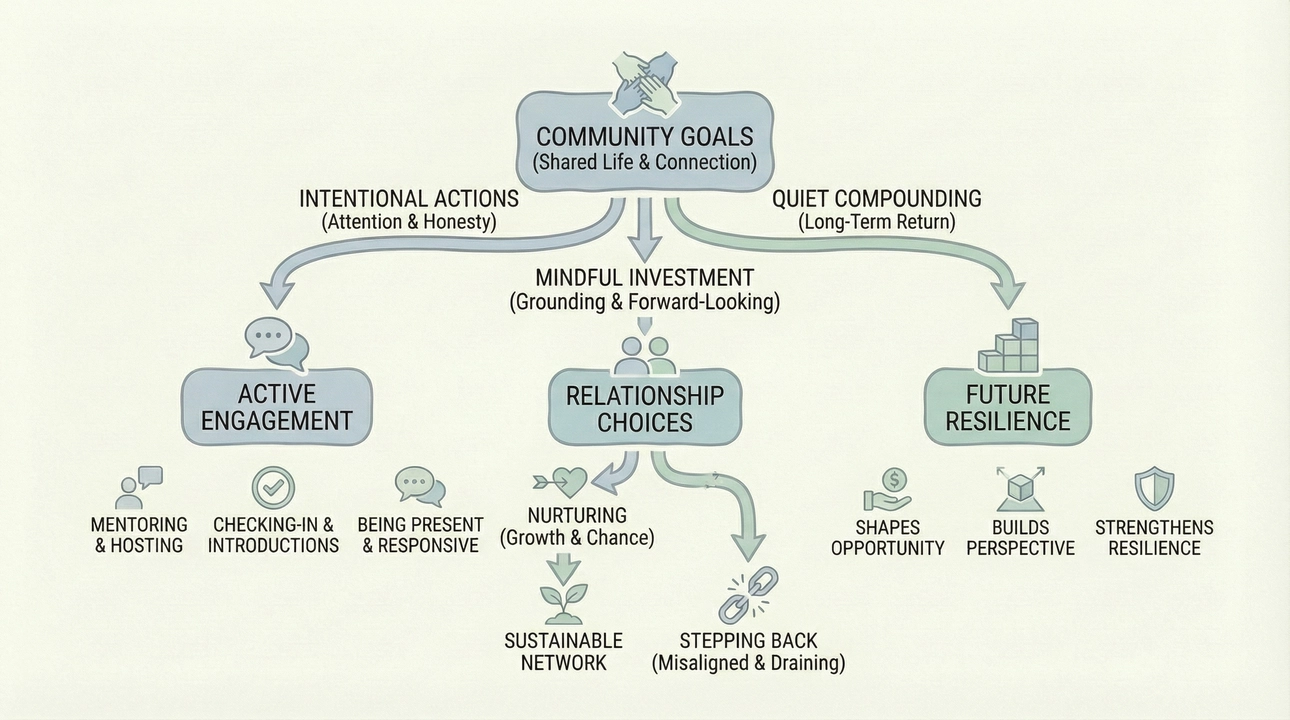
Sometimes this looks like mentoring or hosting. Other times it is as simple as checking in, making introductions, or being more present and responsive. I track this lightly, mostly to ensure it is not the first thing sacrificed when life gets busy.
I have also learned to be mindful of which relationships I invest in most deeply. I value connections that feel grounding and forward-looking, and I try to give people and communities a fair chance to grow. At the same time, I am more comfortable stepping back when something consistently feels misaligned or draining. That, too, is part of maintaining a healthy and sustainable network.
Over time, I have learned that community compounds quietly. The return is rarely immediate, but it shapes resilience, opportunity, and perspective in ways nothing else does.
Turning intentions into daily life
Plans fail when they live only in documents. They work when they fit into real days.
For personal goals, I anchor habits to moments that already exist: mornings, evenings, meals, walks, or weekends. If something requires constant discipline to maintain, I assume the design is wrong.
For community goals, I rely more on prompts than schedules. Gentle reminders to reach out, default openness to help when I can, and creating space for unplanned conversations keep relationships alive without turning them into tasks.
The goal is not rigid consistency. It is presence.
How I check in without pressure
I no longer believe accountability needs to feel heavy to work.
On a weekly basis, I ask simple questions. Do I feel more grounded or more scattered? More connected or more isolated? Am I moving in a direction that feels aligned?
Monthly and quarterly reviews are more reflective. I look for trends rather than perfection and adjust when something feels out of sync.
Some goals stay private. Others benefit from being shared with a small circle of people I trust. That balance helps me stay honest without turning life into a performance.
When I miss a target, I adjust rather than judge. The aim is durability, not flawless execution.
Structure with room for life
Life is not predictable. Interruptions, demands, and opportunities will appear whether I plan for them or not.
That is why I leave slack in the system. If one week goes sideways, it does not undo the quarter. Flexibility is not an excuse to drift. It is permission to adapt while staying anchored to what matters.
A few simple rules help:
If something does not support a longer-term direction, it is low priority
If it cannot fit realistically into available time, it needs to change or wait
If an opportunity meaningfully advances a long-term goal, I make room intentionally

A few reminders I return to
Fewer goals create more follow-through
Clear intentions beat vague hope
Missed targets are information, not failure
Community is often the multiplier we underestimate
Closing thoughts
Planning is useful, but attention is the real currency.
The purpose of this framework is not to run life like a company. It is to protect the things that quietly matter from being crowded out by the things that loudly demand attention.
If you take one thing from this, let it be simple. Choose one personal or community commitment that would make the year feel fuller, not busier. Make it visible. Return to it gently and consistently.
The year will unfold as it will. What matters is where you choose to place your care as it does.