Bridging East and West in Product Design and AI Strategy: How Pakistani Roots and Canadian Experience Inform My Practice

I grew up in Pakistan and spent the first twenty years of my life surrounded by dense cultural narratives, then moved to Canada and spent the next decade and a half learning different systems and assumptions.
That duality is not just personal history. It is the lens I use to design products, to architect systems, and to think about the future of AI. In this post I will explain how the depth of Eastern culture and the structure of Western systems combine to shape my approach to UX, product strategy, and AI-native product design.
I want to give you practical ideas you can use, and a sense of why cultural fluency matters when you build tools that people will live with.
The Two Cultural Lenses I Grew Up With
Growing up in Pakistan taught me to read context. Systems there are layered with family expectations, rituals, and unspoken norms. That creates design constraints that are not visible at the surface level, but are decisive in shaping behavior. People make choices that balance harmony and chaos, community and individual aspiration. Designs that ignore these layers feel brittle or performative.
Canada gave me a different training. Western contexts emphasize explicit rules, modular systems, and scalability. The structure is visible and repeatable. Products are judged by how predictable and auditable they are, and by how well they map to a clearly defined user journey. That clarity is powerful for building processes, teams, and engineering practices.
Neither lens is superior on its own. The East teaches depth, tolerance for ambiguity, and systems that persist through relationships and habits. The West teaches clarity, repeatability, and an orientation to future states.
My practice is to treat them as complementary tools rather than conflicting ideologies.
How East and West Shape My Design Thinking
When I approach a product problem I ask two parallel questions. What is visible and testable, and what is invisible but real. The visible layer is where Western practice excels. We map flows, define metrics, and iterate quickly. The invisible layer is where Eastern practice offers an advantage. We enumerate cultural affordances, anticipate unspoken constraints, and account for how practices evolve over time.
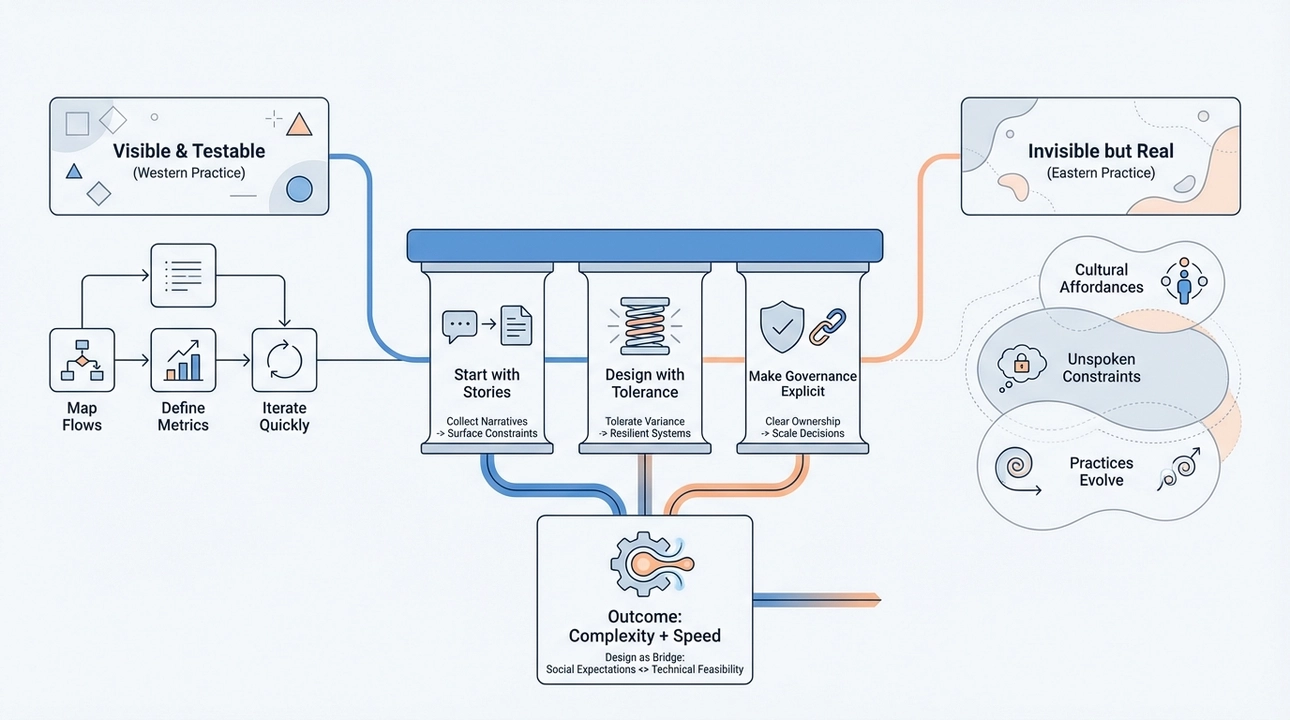
This manifests in three practical habits I use across teams and projects:
Start with stories. I collect narratives from real people before writing requirements. Stories surface invisible constraints faster than surveys or feature lists.
Design with tolerance. Systems should tolerate variance in behavior. Eastern contexts taught me to expect messy, overlapping use cases. I design interfaces and data schemas that are resilient to those messes.
Make governance explicit. From Western training I borrow governance models, version control, and clear ownership. That helps scale culturally sensitive design decisions across product teams and engineering organizations.
Blending these habits helps me build for complexity without sacrificing speed. It also changes the role of design in product development. Design becomes a bridge between social expectations and technical feasibility, not just a deliverable.
Practical Examples from Product and AI Work
I have applied this approach in multiple AI and product initiatives. A few examples illustrate how the East meets West perspective becomes a competitive advantage.
Example 1: Conversational AI in Multilingual Contexts

When building agents that will be used across South Asia and North America, a purely Western user model breaks down. Users in Pakistan may expect indirect phrasing, deferential language, and contextual cues tied to family and community. I design conversational flows that allow for elliptical language and layered follow ups. We instrument conversations to learn implicit preferences rather than forcing explicit selections. At the same time we use Western-style metrics and A B testing to validate hypotheses quickly. The result is an agent that feels natural across cultures, and that can be iteratively improved with hard data.
Example 2: Product Architecture for Resource Variance

Eastern systems taught me to design for variance in access, connectivity, and device capabilities. I build layered architectures where core functionality is available offline or in low bandwidth, with progressively enhanced experiences for users with better resources. This reduces churn in markets where connectivity is intermittent and increases adoption. The Western emphasis on modular APIs and microservices lets us implement that resilience without compromising engineering velocity.
Example 3: Strategy and Team Design

When building teams I combine relational leadership with systems thinking. In practice this means investing time in building trust through mentorship and narrative alignment, while also establishing clear KPIs, reporting cadences, and decision rights. Trust reduces friction in ambiguous situations and systems reduce the cognitive load when scaling decisions across multiple squads.
How to Apply an East Meets West Approach in Your Work
If you want to adopt a similar hybrid approach, here are concrete steps you can take.

Invest in ethnography early. Spend time in the environments where your users live. Observe rituals, language, and social flows. This will reveal constraints that prototypes alone cannot.
Prototype for resilience. Design defaults that work in messy real world conditions. Allow for fallbacks, local adaptations, and progressive enhancement.
Translate cultural insights into measurable hypotheses. Convert qualitative observations into metrics you can monitor so cultural sensitivity does not remain anecdotal.
Create cross-cultural design reviews. Establish an explicit review loop where engineers, designers, and cultural informants validate assumptions before major releases.
Teach teams to tell user stories. Make story gathering a part of sprint cycles. Stories help preserve contextual knowledge as teams scale and change.
Use governance to codify exceptions. Where culture requires exceptions to generalized flows, codify those exceptions so they are visible, owned, and testable.
These actions balance the depth you get from cultural fluency with the scalability you get from Western systems thinking.
Industry Insights and Trends Worth Watching
The industry is moving toward more context aware and agentic systems. As AI agents take on more responsibilities in product lifecycles, cultural context will become a non negotiable factor. Agents trained on single cultural priors will fail to generalize. Agents designed with cultural layers in mind will be safer, more trusted, and ultimately more effective.

Another trend is the demand for resilient architectures that support edge conditions. Markets outside major Western cities will drive innovation in offline first design, adaptive UIs, and lightweight models. Teams that embrace cultural diversity in their design process will have a strategic head start.
Finally, leadership that blends relational intelligence with systems discipline will outperform organizations that emphasize one at the expense of the other. This is true for hiring, roadmaps, and long term product stewardship.
Concluding thoughts
My experience living across Pakistan and Canada is not a personal anecdote to add texture to a resume. It is a working methodology that informs how I build products and lead teams. The Eastern depth I grew up with teaches me to attend to invisible constraints, to tolerate ambiguity, and to design for relationships. The Western systems I adopted teach me to make decisions explicit, to measure rigorously, and to scale reliably.

If you are building products for a global audience, or designing AI systems that will touch diverse lives, investing in cultural fluency is not optional. It is a strategic lever. Start by collecting stories, design for resilience, and codify cultural exceptions into your governance. That combination will help you ship products that are both human and scalable, and that earn trust across contexts.
I will keep sharing more examples from my work at 11X Ventures and from projects across South Asia and North America. If you are interested in practical tools for cross cultural design or agentic product development, I will write about specific frameworks and templates in future posts that you can apply directly to your work.