Charting the Path to Singularity: Exploration, Documentation, and the Agentic Future

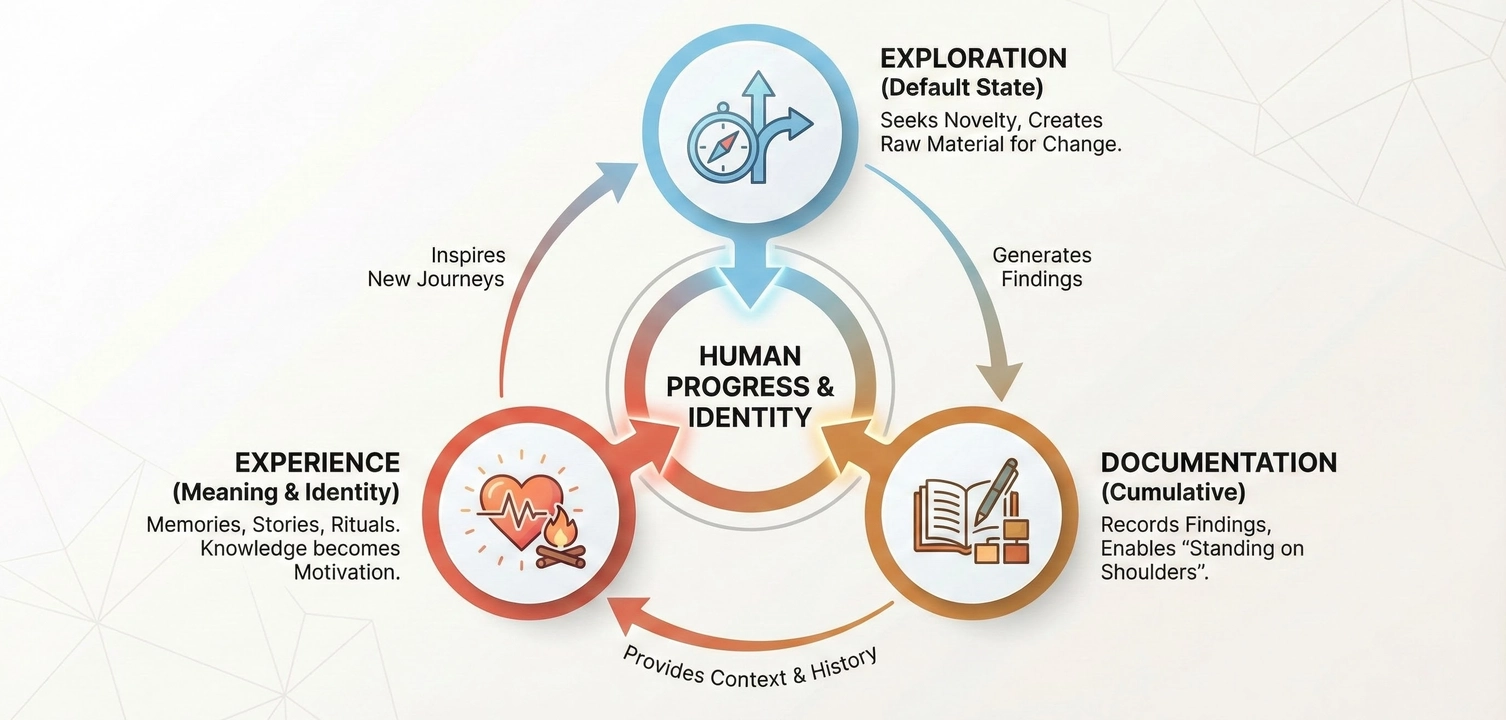
I want to start with a simple observation about what makes us human. At a high level we do three things: we explore, we document, and we experience. Those activities have driven every era of progress we know, from voyages of discovery to scientific revolutions and cultural innovations.
Today those same drives are being amplified by computing power, networks, and machine learning. That amplification is not incremental. It is reshaping how products are built, how organizations operate, and ultimately how collective intelligence forms.
I believe that trajectory will bring us much closer to the idea of singularity than most people realize. In this post I will explain why, show how product cycles provide a practical map of that movement, and offer concrete observations and recommendations for builders and leaders.
The three human drives and why they matter
Exploration is our default state. We seek new places, new models, new hypotheses. Exploration creates novelty and the raw material for change.
Documentation is how exploration becomes cumulative. By recording what we find we enable others to stand on our shoulders.
Experience is what gives exploration and documentation meaning. Memories, stories, rituals and products are how knowledge becomes identity and motivation.
When you look at technology through this lens you see a clear pattern: every platform that amplifies exploration, documentation, or experience increases the pace of change. The printing press documented more knowledge. The steam engine enabled new forms of exploration and production. The internet documented and distributed human experience at global scale. Each leap did not just add capability, it multiplied the speed at which humans could iterate on ideas.
That multiplication is exactly what is happening now with artificial intelligence. Machines are not just faster calculators. They are amplifiers of those three drives. They help us explore by suggesting directions we might not have considered, document by capturing and indexing far more signals than any human team can, and enhance experience by personalizing and synthesizing content at scale.
Moore's law and the compounding velocity of innovation
Moore's law is not a prophecy about transistor counts alone. It is a proxy for an accelerating supply of computational capacity and cost efficiency. When compute gets cheaper and data flows increase, the feedback loops that power innovation tighten. Models train faster, experiments complete in hours not weeks, and new behaviors emerge from compositions of previously discrete systems.
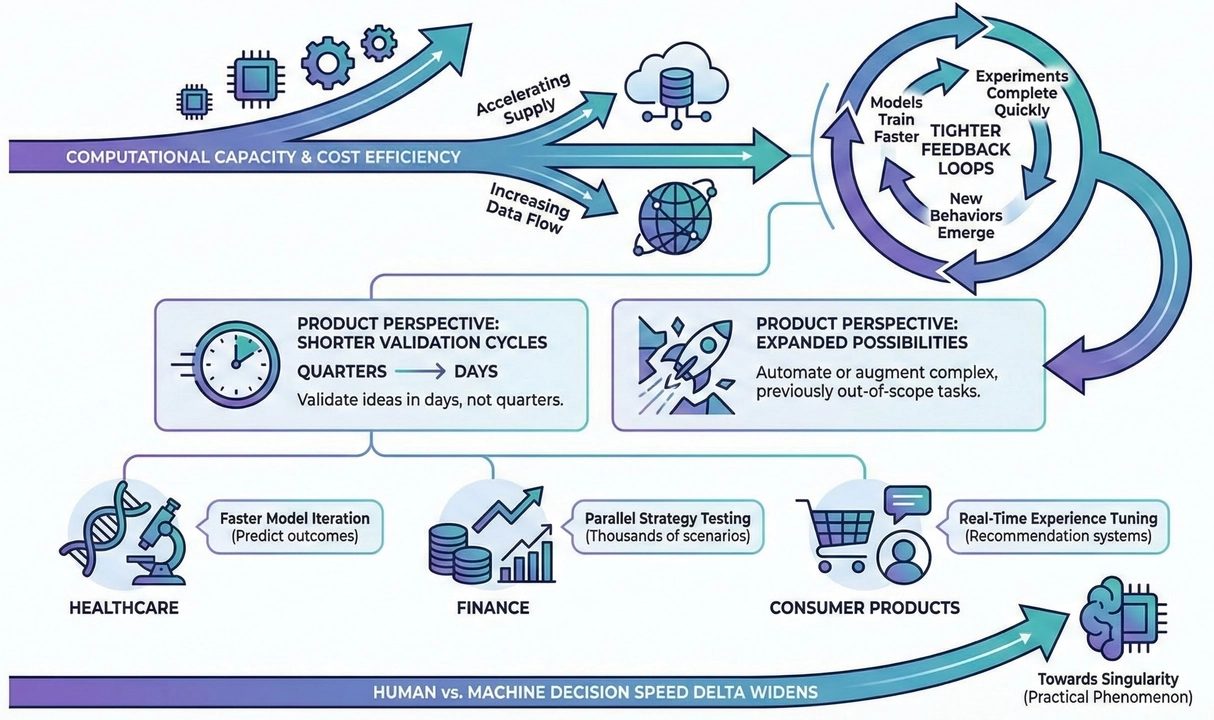
From a product perspective this means two things. First, the time horizon for validation shortens. What used to take quarters to learn now takes days. Second, the envelope of what is possible expands. Tasks that were previously out of scope because of complexity or scale become viable to automate or augment.
That compounding is visible across industries. In health care researchers iterate on models that predict outcomes faster, in finance algorithmic strategies test thousands of scenarios in parallel, and in consumer products recommendation systems tune experiences in near real time.
As compute continues to follow its historical trajectory, the delta between human decision speed and machine-augmented decision speed widens. That delta is the operational heart of the movement toward singularity as a practical phenomenon rather than a distant metaphysical idea.
A micro-level view: how product development cycles evolved and what it reveals
I want to describe a practical example from my work to make this tangible. The products I built a decade ago followed a waterfall or stage gate approach. We planned, built, and shipped. Feedback arrived late and changes were expensive.
Agile introduced rapid iteration, reducing cycle time and enabling continuous delivery. Lean practices shortened cycles further with rapid experiments and smaller bets.
But what I am seeing now feels qualitatively different. I call it the Agentic cycle. Where previous cycles optimized for speed and risk mitigation, the new cycle embeds an identity and agency layer within every component of the product lifecycle. Each sub-system, whether it is a feature, a data pipeline, or a decision process, starts to carry a persistent representation of intent and capability. That representation can be queried, composed, and delegated to other subsystems or agents through MCP integrations.

Concretely, this shows up as: one, components with their own short term memory and preferences; two, continuously updating identity layers informed by user behavior and cross product signals; and three, orchestration layers that assign tasks to specialized agents rather than to monolithic services. The result is a mesh of faster loops where orchestration becomes the lever for exponential scale.
Consider a time-boxed example. In a recent product iteration we used human-in-the-loop experiments to identify user intent signals that predicted conversion. Previously we would instrument, collect, analyze, then iterate over weeks. In our current approach a set of models continuously harvests micro signals, builds an evolving intent vector, and routes experimentation variants in real time. We moved from weekly sprints to live meta-experiments that refine themselves. The speed of learning increased an order of magnitude while human oversight shifted from low level tuning to high level governance.
That is not just faster product development. It is a different class of product architecture where the product begins to approximate an agentic system that can explore, document, and optimize its own behavior.
Understanding human intent at scale and the social implications
Platforms like TikTok and short form video ecosystems are early examples of this new capability. They do not just distribute content. They model attention and intent with unprecedented granularity. The hooks are optimized through feedback loops that teach the system what people want to watch next. That learning is then used to surface content, extend sessions, and influence preferences.
This is where the promise and the risk intersect. On the one hand, systems that understand intent can be liberating. They can reduce friction, surface opportunities, and democratize access to knowledge. On the other hand, the same mechanisms can shape decisions in ways that concentrate influence and reduce the diversity of future choices.
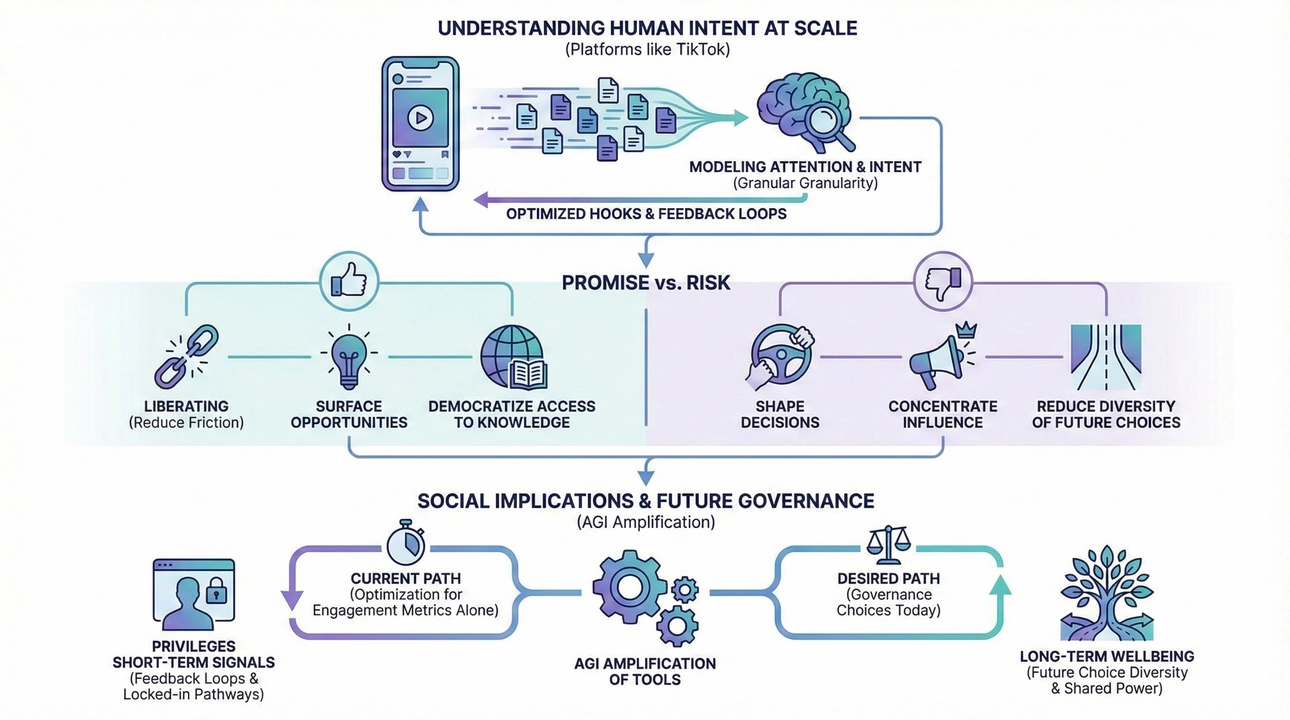
AGI or general intelligence is not inherently hostile. It is an amplification of the tools we already use. As builders we must accept two realities. First, deployed intelligence will change the distribution of decision making power. Second, governance choices we make today can lock in pathways that become hard to reverse later. If an agentic ecosystem optimizes for engagement metrics alone, it will create feedback loops that privilege short term signals over long term wellbeing.
Practical recommendations for leaders and builders
I focus on practical next steps because compassion without structure is just rhetoric. Here are four principles I follow and recommend.
Design for composability and identity. Build systems where components expose bounded capabilities and an identity so they can be orchestrated safely. This makes governance tractable and reduces catastrophic coupling.
Shift human roles to stewardship. Human teams should move from micromanagers of behavior to stewards of objectives, ethics, and failure modes. Train people to ask high level questions about alignment, not to tune individual hyperparameters.
Invest in transparent intent signals. Signal hygiene matters. Capture the features that explain why a system made a decision, not just the decision itself. This aids auditability and accountability.
Emphasize pluralism in objectives. If every system optimizes a single metric, society narrows. Reward architectures that balance multiple objectives and that allow for human override and exploration.

These are not just technical prescriptions. They are organizational imperatives. Culture, incentives, and product design must align if the systems we build are to serve collective wellbeing.
Where singularity fits into this picture
When people talk about singularity they often imagine a sudden event where machines outpace human intelligence in every dimension.
I prefer to think in terms of trajectories and emergent capabilities. Singularity is less a switch and more a phase in which agentic systems become continuously better at aligning exploration, documentation, and experience at scale. The outcome is a world where many decisions we currently make collectively are mediated by systems that can aggregate data, predict intent, and propose optimized actions.
That sounds dramatic, but it is also a predictable result of compounding gains in compute, data, and improved product paradigms.
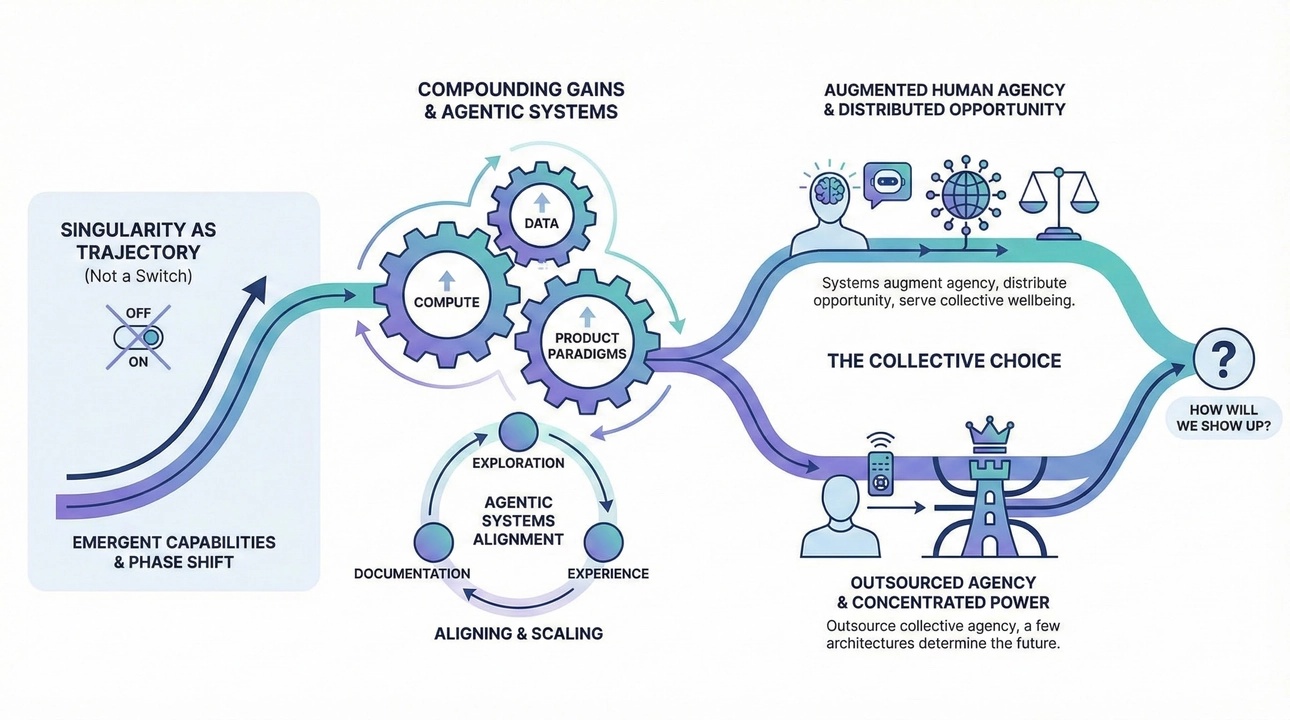
The real question is not whether it will happen but how we show up. Will we design systems that augment human agency and distribute opportunity? Or will we outsource too much of our collective agency and let a few architectures determine the shape of our future?
Concluding thoughts
I believe the movement toward singularity is an extension of our deepest human drives rather than an external shock. Exploration, documentation, and experience are being amplified by agentic systems that learn faster and operate at scales we could only imagine a few decades ago. That creates enormous opportunity and corresponding responsibility.
For builders, the invitation is clear. Treat product design as a civic act. Build composable, auditable systems that preserve pluralism and human stewardship. For leaders, the task is to reconfigure incentives and governance so that the speed of learning does not outpace our capacity to interpret and guide it.
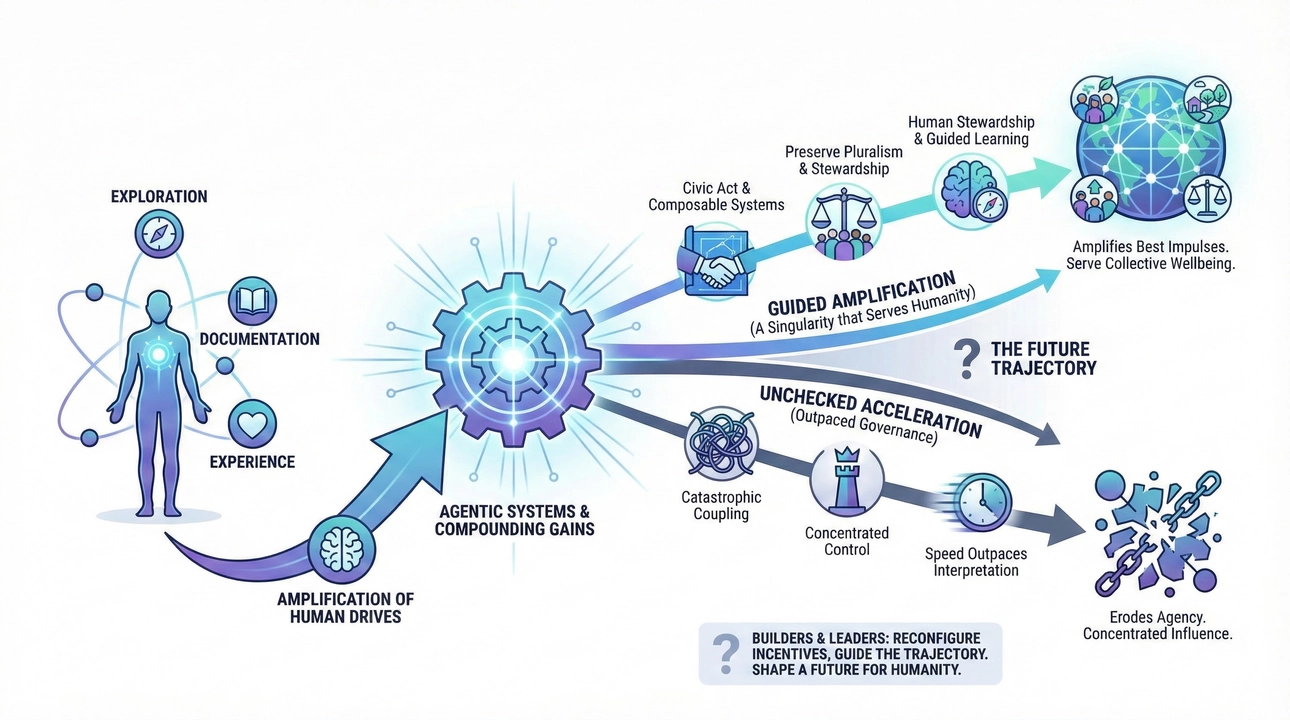
We tend to underestimate what is possible in the long run and overestimate what is possible in the short run. If we keep that in mind, we can shape the trajectory toward a future that amplifies our best impulses as explorers, documenters, and experiencers. That is the practical path toward a singularity that serves humanity.