From Blank Page to First Paying Customer: What It Really Takes to Build in Voice AI Content
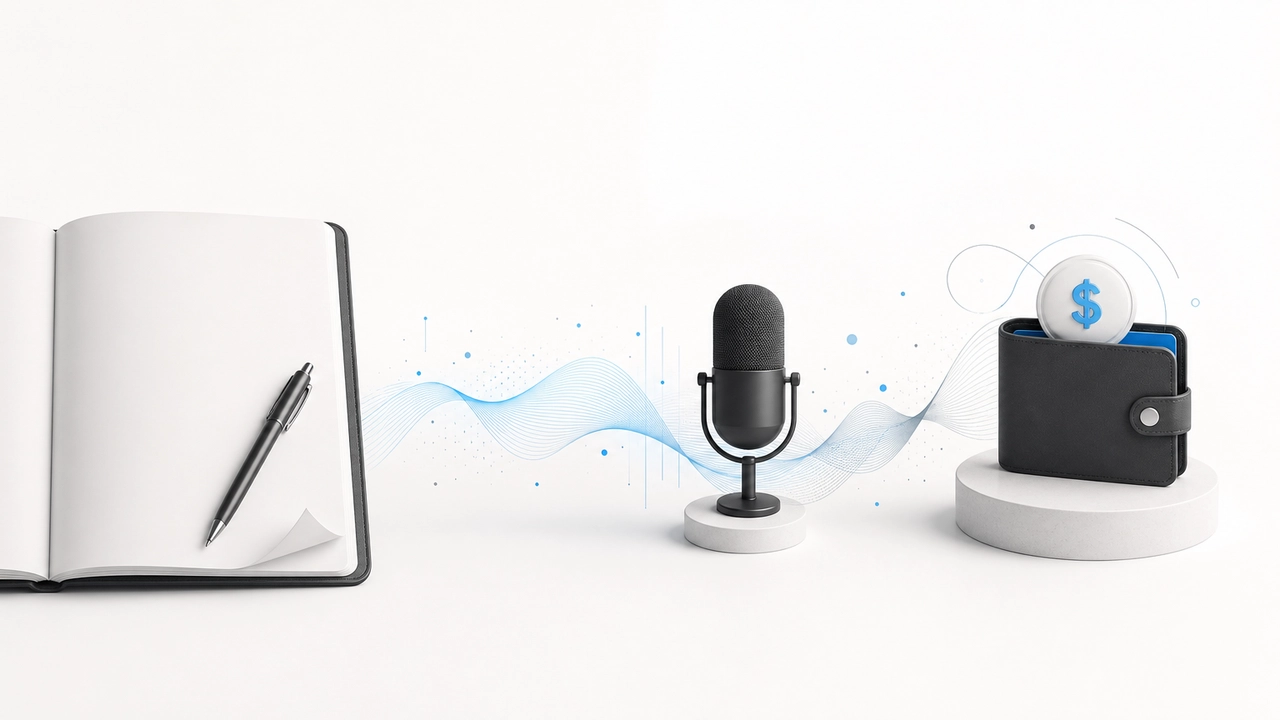
The hardest part of building a product is not the technology, instead it’s figuring out the exact moment where a real person stops feeling stuck and starts feeling capable. That is the thing I have been chasing with Bono AI for over a year, and it started not with a grand vision but with a failed website builder and a room full of people ignoring the thing I built for them.
Getting to your first paying customer, someone who has never met you, has no reason to trust you, and still pulls out their credit card, is the real proof that you have built something worth building.
Here is what it actually took to get there.
The Blank Page Is Not a Writing Problem
Most people I talk to, experts, executives, consultants, creators, professionals with ten or fifteen years of experience in their field, are walking around with genuinely interesting ideas in their heads. They have hard-won perspectives on their industries. They have things worth saying.
And then they open a blank page and nothing comes out.
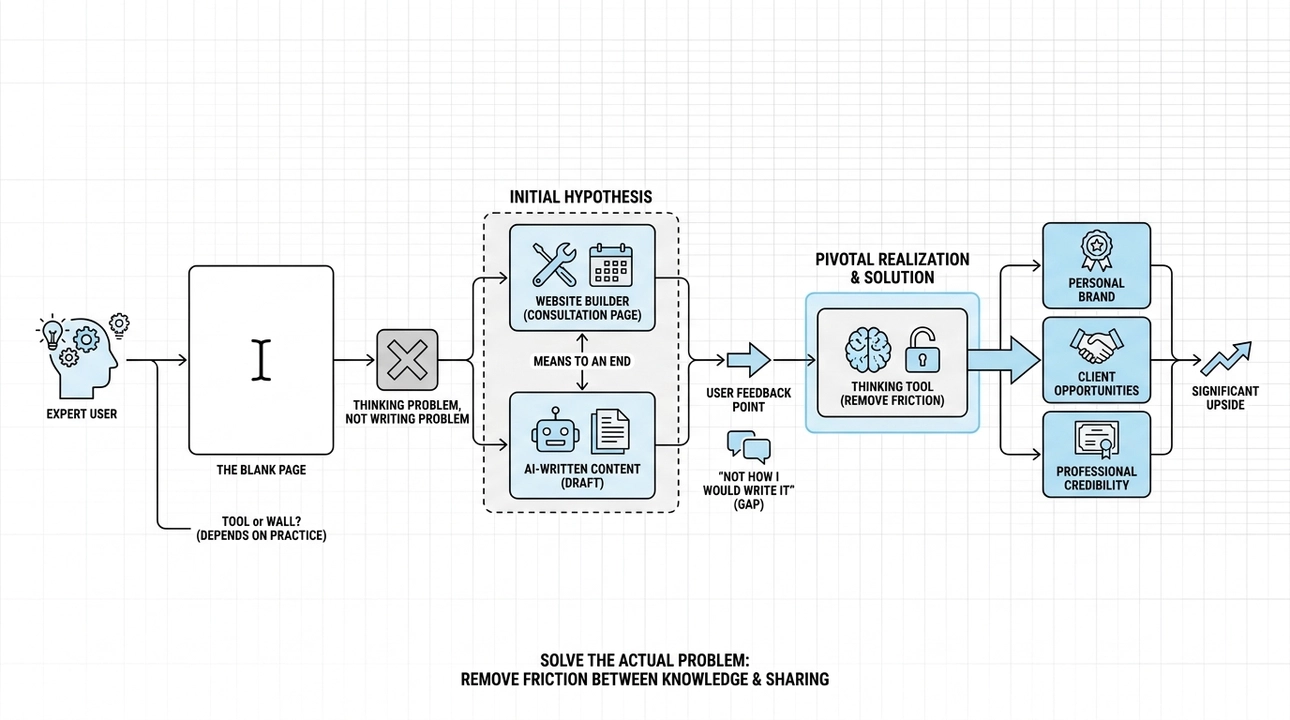
That is not a writing problem. It is a thinking problem. The blank page is a tool, and like most tools, it rewards people who are already practiced in using it. For everyone else, it becomes a wall. You are driving somewhere and an idea hits you, a real one, the kind that took years of experience to arrive at. And you know that by the time you sit down at a keyboard, the shape of it will have already started to blur.
I originally came at this from a completely different angle. I was building a website builder aimed at consultants and fractional executives, people with deep expertise who just needed a simple way to show up online with a paid consultation page and a little content around their work. The hypothesis was straightforward: these people do not have time to build websites, so we will do it for them.
What happened next changed everything. When users saw the product, they walked straight past the website. They barely looked at the consultation booking feature. What they could not stop reading was the AI-written blog post we had drafted on their behalf. And almost every single person said the same thing: "This is interesting, but this is not how I would write it."
That sentence cracked the whole thing open for me. They were not disappointed by the quality of the writing. They were frustrated by the gap between what the AI said and who they actually were. They wanted their ideas to take form, not a generic version of their ideas. The website was a means to an end. The thinking was the end.
From that moment, I stopped building a website tool and started building something that could solve the actual problem: how do you remove the friction between what someone knows and what they can share with the world? Solve that, and you unlock personal brand, client opportunities, professional credibility. You name it. The upside is significant. The challenge is that the friction is real and layered, and you have to dismantle it piece by piece.
Three Friction Points That Took Over a Year to Solve
The first one, and the one I underestimated the most, was voice and conversation.
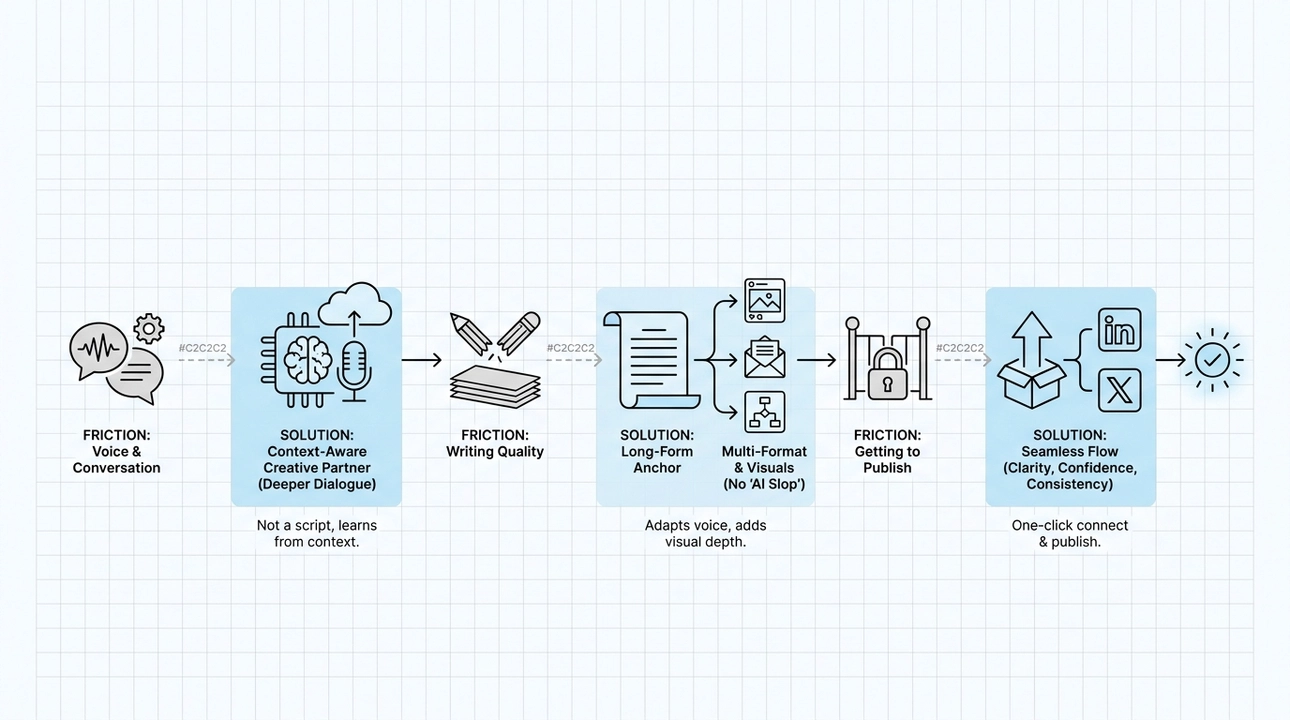
Building a conversational agent that people actually want to talk to is genuinely hard. Not technically hard in the way people assume, but experientially hard. We went through so many different voices, so many different ways of structuring the dialogue, so many approaches to asking the right question at the right moment. It took close to a year of iteration. I am not being dramatic about that timeline. I mean we tried and failed and tried again across models, across prompts, across the entire communication architecture.
The goal was never to create a longer conversation. It was to create a deeper one. A meaningful one. Where someone feels like they are talking to a creative partner who is genuinely curious about what they think, not a form that happens to speak. We built a mechanism that can pull in additional context mid-call, so the agent is not just working from a script but actually learning about the person as the conversation unfolds. When people tell me they love the experience now, and when I see engagement going up, that is the result of that work. But if we had shipped early on that layer, none of the rest would have mattered.
The second friction point was the writing itself.
Once someone has that conversation, something has to come out the other side that actually sounds like them. Not like a content mill. Not like a prompt dropped into a generic model. Like them. The decision we made early, and I think it was the right one, was to always default to long-form as the primary output. Not a quick summary. Not a listicle. A real piece that captures someone's thinking in full.
That decision came from watching what happens when AI-generated content gets too short, too surface-level. You end up in what I call AI slop territory. The content exists, but it does not represent anyone. Long-form forced us to go deeper, to stay honest, to make sure the piece could hold up under scrutiny. From that long-form anchor, we then built the logic to transform it into channel-specific formats: LinkedIn, X, newsletter, blog. Each one adapts the voice and the format without losing what the person actually said.
We also added a visual layer. For every content piece, there is a central image that distills the idea into a single hook. And within the piece itself, different sections can have their own visual representation, whether that is a diagram, a minimal illustration, or something more conceptual. Not every reader absorbs ideas the same way, and visual elements add a layer of depth that text alone sometimes cannot carry.
The third friction point was the one that decided whether any of this actually mattered: getting people to publish.
You can build the most beautiful, authentic content experience in the world, and if someone reads their draft, feels good about it, and then closes the tab, you have created zero real-world value. The moment that changed everything for us was when we got the publishing flow right, where someone could connect their LinkedIn or X account and go from a first call to a live post without stopping to think too hard about it.
That is the aha moment I was engineering toward the whole time. Not the conversation. Not the writing. The publish button being pressed by someone who never thought they had the time, the skill, or the confidence to share their perspective publicly.
The three things Bono is built around are clarity, confidence, and consistency. Getting someone's ideas into clear form is step one. Giving them the confidence to share those ideas is step two. Helping them do it over and over without it feeling like work is step three. The publishing feature is where confidence lives.
What Landing the First Paying Stranger Actually Means
When someone who does not know you, has no existing relationship with you, and has no particular reason to trust you decides to pay for something you built, that is the clearest signal you can get. It means the product did the convincing on its own. Not your pitch. Not your network. The experience itself.
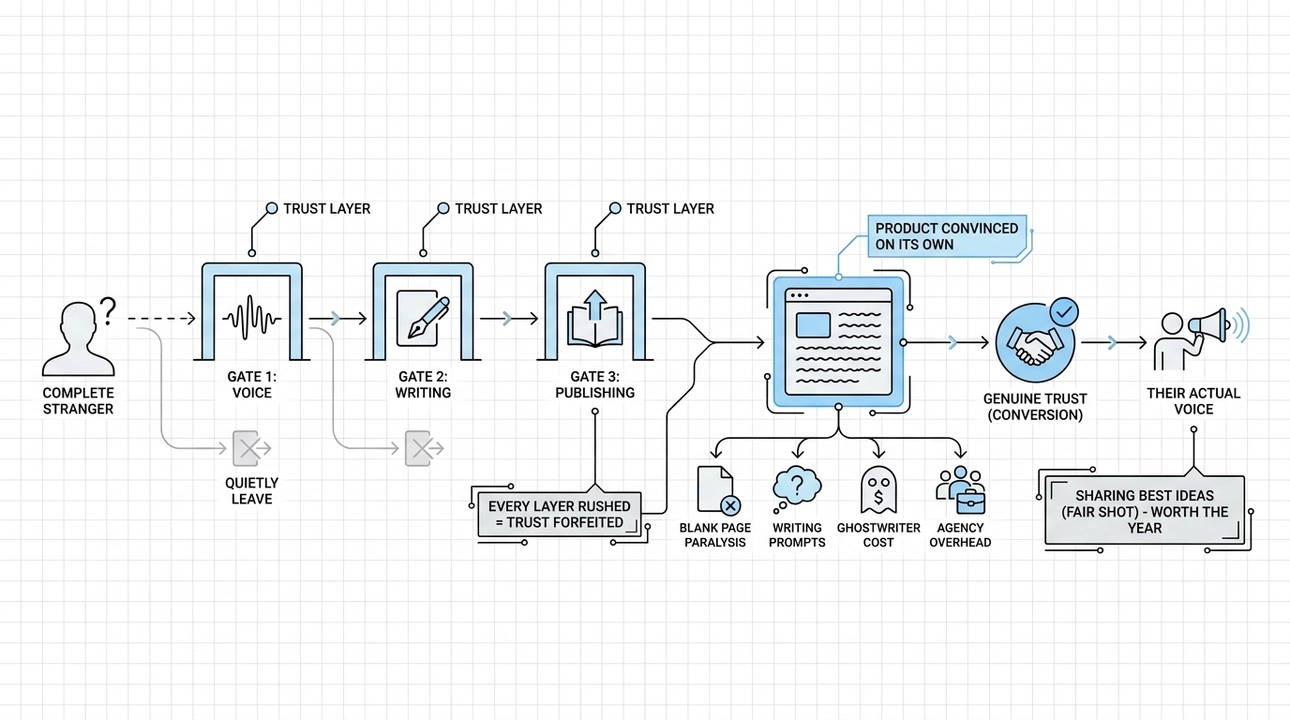
The first few customers who converted on Bono were people who went through that full arc: the conversation, the long-form piece, the visuals, the publishing flow. They realized that what they were holding in their hands replaced several things at once: the blank page paralysis, the need for writing prompts, the cost of a ghostwriter, and the overhead of working with a content agency. One experience. One flow. Their actual voice.
That is what a year of iteration was for. Not to ship something impressive on a demo. To earn that moment of genuine trust from a complete stranger.
If you are building in this space, the lesson I keep coming back to is this: every layer you rush is a layer of trust you forfeit. The voice, the writing, the publishing. Each one is a gate that users will walk up to and either pass through or quietly leave. The only way to get them through all three is to treat each one as if it is the only thing that matters, because for that specific user, in that specific moment, it is.
Building something that disrupts how people communicate their thinking is not a small bet. But if it works, and I believe it does, the people who have been sitting on their best ideas for years finally get a fair shot at sharing them. That is worth the year it took to get here.