The CDP Playbook: Building a MarTech Engine That Actually Works
CDP, MarTech, and a Two-Year Transformation
One of the most complex, and ultimately rewarding, projects I led at Enchant was the implementation of a Customer Data Platform (CDP). Over two years, we transformed a fragmented marketing tech stack into a cohesive data powerhouse that supported over 3 million unified customer records. We implemented Segment CDP first and then decided to migrate over to Customer IO.
This post is a deep dive into how we did it, what we learned, and why getting your CDP right is the foundation for any meaningful marketing automation, personalization, and analytics strategy.
p]:ml-2">While this was a large-scale B2C initiative, the principles absolutely apply to B2B, especially if you're running multiple campaigns, managing partners, or segmenting accounts. At an early-stage startup, a full CDP might feel like overkill, but even partial implementation (tracking, identity stitching, etc.) can give you a major edge.
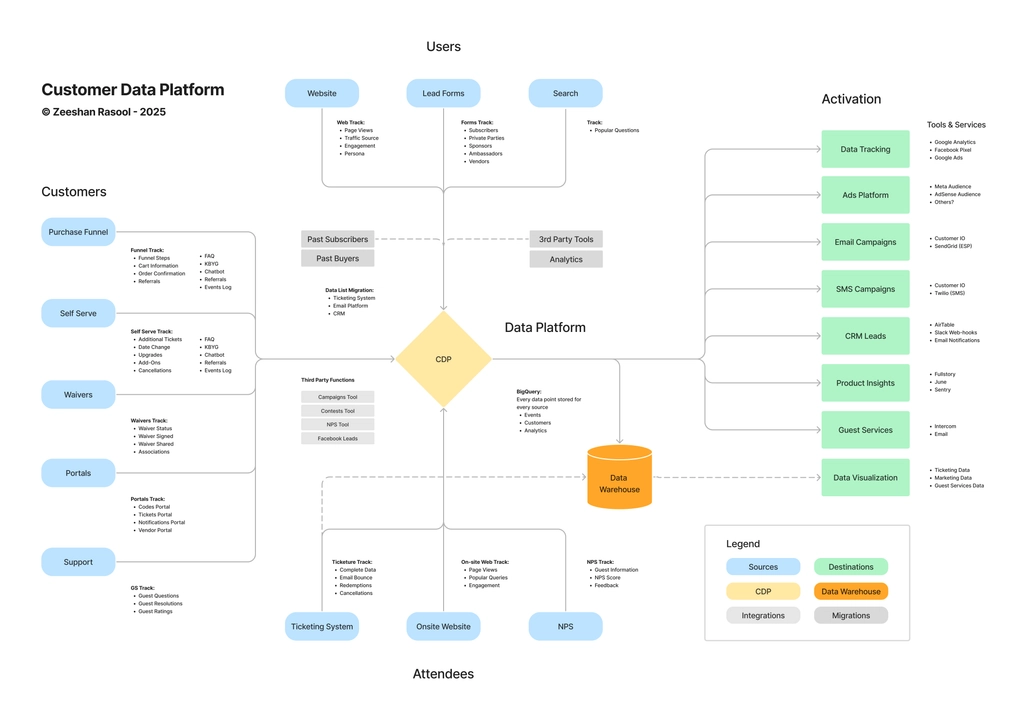
A detailed and high-quality CDP architecture diagram PDF version is available at the end of the post.
The Martech Chaos We Started With
Before our CDP initiative, our marketing systems looked like this:
- li]:my-1">
Email campaigns ran on Mailchimp — disconnected from guest records.
Ad platforms required manually exported customer lists.
Analytics pulled from a patchwork of CRM, sales, and support platforms.
Support interactions, purchases, web activity, and form fills all lived in silos.
The lack of integration didn’t just slow us down, it made it impossible to launch timely, contextual campaigns at scale. In addition, it made different teams spend most of their time on tedious requests, which only slowed down on real value add.
p]:ml-2">This is a common pattern across growing orgs. Each tool solves one problem in isolation, but without a unified foundation, your team ends up fighting the stack instead of leveraging it. Even B2B startups hit this wall when running ABM campaigns or product-led growth strategies.
Why CDP Was the Missing Link
At its core, a Customer Data Platform helps you unify data from every customer touchpoint into a single profile. With that foundation, you can:
- li]:my-1">
Activate that data across marketing, support, product, ops and sales tools.
Personalize every channel with consistent, real-time customer context.
Own and structure your data inside a long-term data warehouse.
Without this foundation, your team will always be stuck stitching CSVs together or worse, sending irrelevant messages to the wrong people.
p]:ml-2">The CDP becomes your system of record for user behavior. For B2B, it can unify data across tools like Salesforce, HubSpot, website activity, and success metrics — enabling more accurate scoring, lead routing, and nurture.
The Design: A Unified Data Strategy
We took a layered approach to designing our customer data ecosystem:
- li]:my-1">
Sources: Website, lead forms, email platforms, ticketing, guest services, third-party analytics, and more.
CDP: We explored several options (see below) and landed on Customer IO for its flexibility, native integrations, and support for custom event data. We originally worked with Segment CDP but had to move out of it since it became too technical.
Data Warehouse: Long-term storage in BigQuery allowed us to do deep analysis, reporting, and maintain ownership of all data. Irrespective of our annual stack decisions, we had historical data on all users.
Destinations: Ads platforms, email/SMS tools, CRMs, analytics platforms, guest tools, and internal dashboards.
p]:ml-2">Think of this as your MarTech nervous system. Partial implementations work too, even just having structured event tracking across a few key tools can lay the groundwork for advanced workflows later.
4. Top CDPs We Evaluated
We evaluated multiple platforms based on scalability, integration support, pricing, and ability to customize:
- li]:my-1">
Segment: Powerful, but costly at scale. Great for engineering-heavy teams.
mParticle: Enterprise-focused with solid mobile SDKs.
Customer IO: Best balance of marketing-friendly UI, rich automation features, and data flexibility.
RudderStack: Open-source friendly, but less mature ecosystem.
Why we chose Customer IO
It allowed us to combine marketing automation and CDP functions, reducing our stack complexity. It was flexible enough to receive structured events and easy to use for marketing and product teams alike.
p]:ml-2">For startups or B2B orgs, the tooling decision depends on team makeup. If you’ve got strong engineering, Segment or RudderStack may be worth it. If you want fast marketing-led workflows, Customer IO is a solid bridge between automation and data infrastructure.
Implementation Milestones
We phased implementation into these key steps:
- li]:my-1">
Data Mapping: Audited all customer touch points and defined key events and attributes.
Tracking Setup: Web, CRM, forms, ticketing, guest services, and email events were piped into the CDP.
Profile Stitching: Consolidated user records into a single source of truth.
Data Warehouse Sync: Every event was backed up to BigQuery.
Activation: Built automated journeys across email, SMS, and ads.
Visualization: Created dashboards for marketing, product, and guest services.
Each step needs to be carefully planned, implemented and tested to ensure reliability.
Requirements Checklist
We designed the implementation to cover the full lifecycle of customer data use across functions. Each function mapped directly to a real use case:
- li]:my-1">
Web Analytics → Page views, events, device stitching (e.g. GA4, Plausible)
Commerce → Ecom, purchase flow with orders and cart-abandonment
Ads Integration → Google/Facebook audience sync
Forms → Subscriber, leads, forms tracking (custom or Typeform)
Customer Service → Guest interaction ingestion from Intercom
Product Data → Event tracking (e.g. FullStory, June)
Personalization → Custom attributes for web and email targeting
Social Listening → Sentiment inputs, UGC tagging
Marketing Automation → Audience segmentation, campaign triggers, lead scoring
Data Governance → Migration support from old CRM, ESP, ticketing
Visualization → Custom dashboards from warehouse data
p]:ml-2">Every requirement here maps to a real use case. For B2B, simply swap out the touchpoints — product usage, support tickets, demos, etc. You don’t need everything on day one, but defining your essentials upfront saves pain later.
Real-World Outcomes
The difference post-implementation was night and day:
- li]:my-1">
Unified 3M+ customer records across 20+ sources.
Doubled campaign speed from ideation to launch.
Reduced manual list pulls by 90% for email and ads.
Increased relevance of outreach using real-time behavioral triggers.
Improved ownership by housing all data in our own warehouse.
p]:ml-2">Even if your list isn’t in the millions, stitching 5–10 tools together can reduce weeks of campaign prep. That time savings is a multiplier for startups trying to move fast.
Lessons Learned
- li]:my-1">
Buy-in is critical: You’ll need alignment from marketing, product, data, and ops teams.
Start with tracking: You can’t personalize what you can’t track. Define your key events early.
Data warehouse is non-negotiable: Third-party tools come and go — your warehouse is forever.
Choose tools your team will actually use: Fancy dashboards don’t help if no one logs in.
p]:ml-2">B2B companies: Don’t let data strategy become an afterthought. The longer you wait, the messier retroactive stitching becomes. A small early investment pays dividends when you scale.
The Future: AI + CDP
With foundational customer data in place, the best way to take your MarTech powered by CDP setup is through leveraging further automations through AI. Some areas to consider are:
- li]:my-1">
Predictive personalization using NPS, purchase, and engagement data.
LLM-powered agents for customer support and content creation.
Audience modeling using first-party data + embedded ML.
p]:ml-2">This is where things get exciting. However, none of it is possible without clean, accessible, and structured customer data. Think of the CDP as the engine; AI is just the turbocharger, and it will only work when the base is right.
Final Thoughts
Implementing a CDP isn't just a tech decision, it's a strategic one. It changes how your entire organization thinks about customers, data, and marketing.
If you’re scaling a B2C or B2B business and you’re still stitching data across Mailchimp, Google Sheets, and legacy CRMs, consider this your sign to start planning your CDP strategy.
Even partial implementation (identity stitching, behavioural event tracking, centralizing form data) can drastically improve the way you operate.
Feel free to connect if you’re building something similar, I'm always happy to share deeper insights and findings from my experience with this approach.