The Cost to Build Is Now Table Stakes: The Three Pillars of Next-Generation Software

Everyone is celebrating how cheap it has become to build software. And they are not wrong. The cost to spin up a product has collapsed. What used to take a team of engineers and eighteen months can now take a small crew and a few weeks. That is a real shift, and it matters.
But here is the problem with the conversation happening right now: it stops there. The cost to build is becoming table stakes, not a competitive advantage. The builders who are treating it as a finish line are going to find themselves with a fast, cheap product that nobody uses, integrates with nothing, and behaves like a very sophisticated form. The real question was never how quickly something can be built. It is what you are building around.
There are three architectural decisions that separate the next generation of software from everything that came before it. Most builders are thinking about one of them. Almost nobody is thinking about all three from day one.
The Integration Stack Is the New Distribution
The first pillar is integration, and understanding it requires thinking about how this layer has evolved.
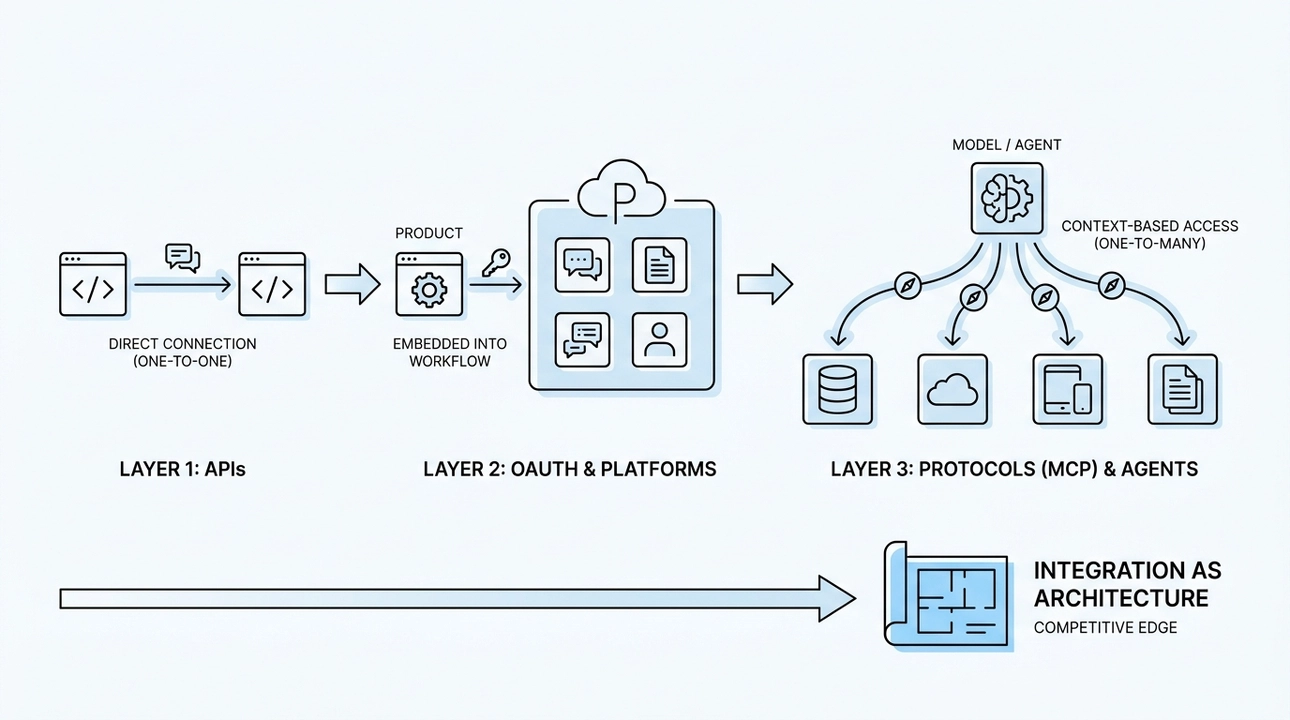
APIs were the foundation. They opened up the ability for software to talk to other software, and that unlocked a massive wave of product development. Then came OAuth and platform-level integrations, which made it possible for products to embed themselves into existing workflows and ecosystems with far less friction. That second wave changed distribution entirely. Getting into a Slack, a Salesforce, or a browser extension stopped being a technical challenge and became a strategic one.
Now there is a third layer forming around protocols like MCP (Model Context Protocol), and it introduces a new kind of complexity. Earlier integration patterns were largely one-to-one: a product connects to a specific tool through a specific defined path. The new paradigm is one-to-many, where a model or agent can reach across a wide range of connected systems based on context rather than a hard-coded instruction. Think of it as the difference between giving someone a specific door to walk through versus giving them access to one hundred doors and letting them choose based on what they are trying to accomplish.
That flexibility is powerful, but it introduces variation and uncertainty that earlier integration models did not have to reckon with. The design and trust challenges that come with a one-to-many integration model are genuinely new territory. Standardization is still evolving. Behavior across connected systems is harder to predict. And yet, this is exactly where the next layer of competitive advantage is being built. The products that figure out how to navigate this layer early, and do it gracefully, are going to have a distribution edge that is very hard to replicate later.
Integration is not a feature. For the next generation of software, it is the architecture.
The Conversational Layer Is the New Interface
The second pillar is the conversational layer, and it is evolving faster than most product roadmaps are accounting for.
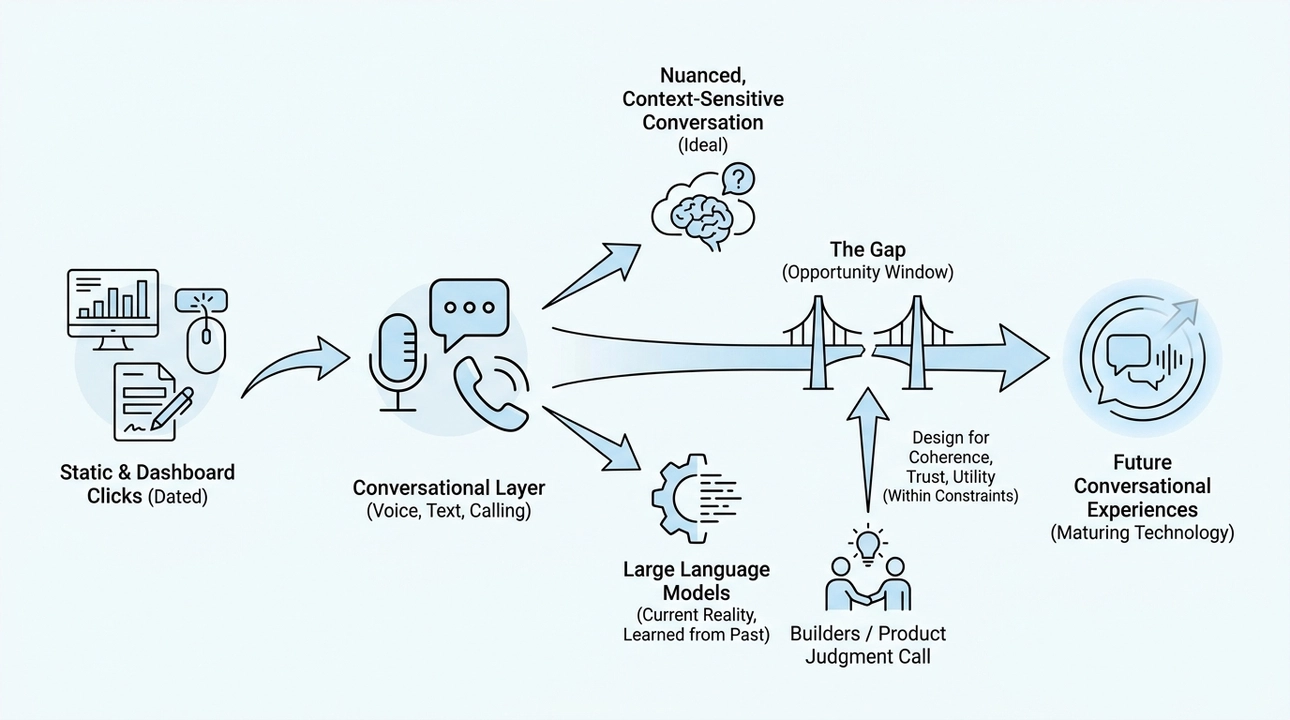
Voice, text-based conversation, and calling are no longer just alternative input methods. They are becoming primary interfaces, and they are rapidly reshaping user expectations around what software should feel like. A product that communicates in static forms and dashboard clicks is starting to feel dated in the same way a website without mobile optimization felt dated a decade ago. The shift is not complete, but the direction is clear.
What makes this particularly interesting is the gap that currently exists between the promise and the reality. Large language models have absorbed an extraordinary amount of information, but real-time, nuanced, context-sensitive conversation is still an unsolved problem in a meaningful sense. The models are capable, but they are learning from what has existed before, not from the conversational design principles that the next generation of products will need to establish. That gap is actually an opportunity window for builders who understand it clearly.
The edge in this moment does not go to the team with the best underlying model. It goes to the team that understands how to design conversational experiences that feel coherent, trustworthy, and genuinely useful within the current constraints, while building toward what those models will be able to do as the technology matures. That is a product judgment call, not a technical one. And most products are not making it well.
The Agentic Layer Is Infrastructure, Not a Feature
The third pillar is agentic capability, and it might be the least understood of the three, even as it gets the most hype.
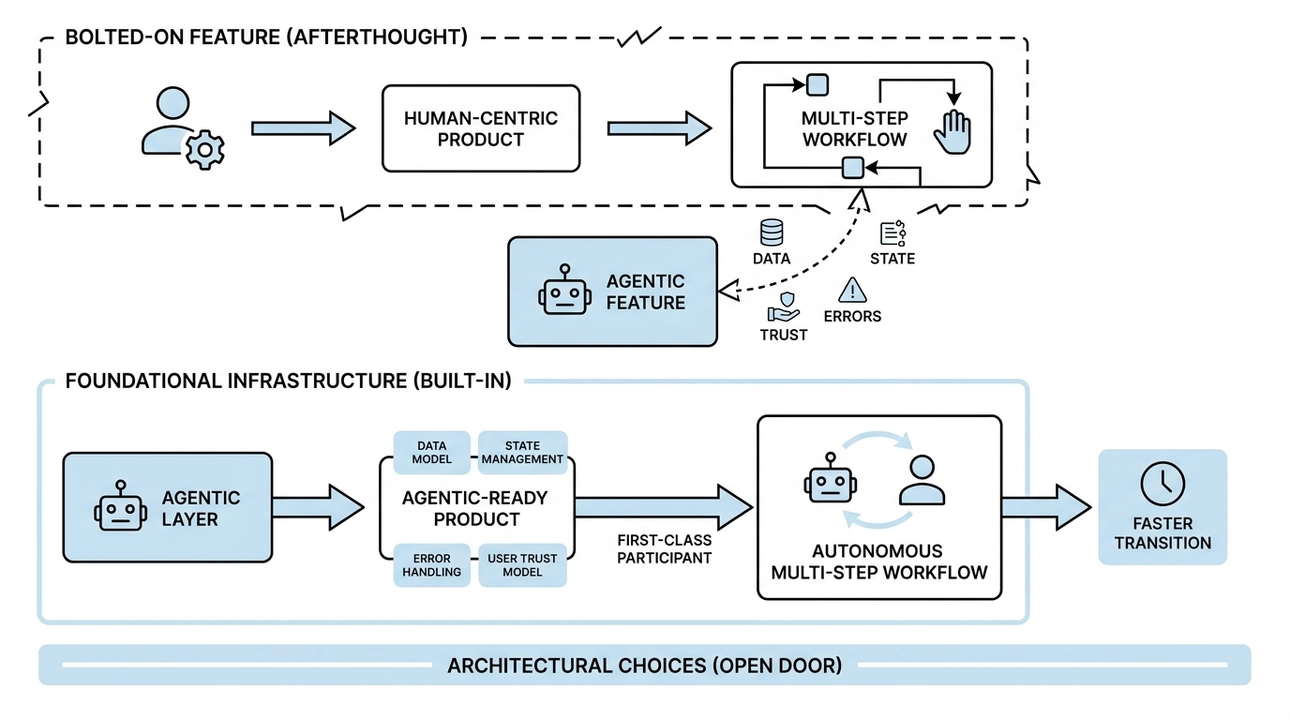
The concept of autonomous software agents, systems that can take actions, make decisions, and move through multi-step workflows without constant human input, is genuinely compelling. The frameworks exist. The philosophical case for it is well established. But the reality is that most implementations are still in infancy. The architecture is there; the reliable, production-grade execution is not yet.
What that means for builders is important: the agentic layer cannot be bolted on later as a feature. It has to be considered as infrastructure from the beginning. A product that is designed around a human completing each step cannot easily be refactored into one where an agent handles those steps autonomously. The data model, the state management, the error handling, the user trust model: all of it looks different when the agent is a first-class participant in the workflow rather than an afterthought.
Building with agentic design in mind from the ground up is not about implementing agents on day one. It is about making architectural choices that do not close the door on them later, because the transition from human-in-the-loop to agent-in-the-loop is going to happen much faster than most product teams are planning for.
What the Next Chapter Actually Requires
Here is the honest summary of where things stand: using today's tools to build software is the easy part. Knowing what to build around is the hard part.

Vibe coding, prompting, orchestration: all of it can help produce something functional very quickly. But none of it teaches the architectural instinct required to design a product that is deeply integrated into the ecosystems where its users live, that communicates in ways those users actually want to engage with, and that is ready to operate with increasing autonomy as the underlying technology matures.
These three pillars, integration, conversation, and agentic design, are new territory in a very specific sense. There is not enough precedent for any model or framework to have fully learned from. That means the builders who figure this out are doing so through judgment, pattern recognition, and a willingness to think beyond the build itself.
The cost to build was never the moat. It was always the map. The question is what gets built with it.