The End of the Empty State: How AI Makes Products Feel Alive from Day One

Most products lie to users on the first day. Not intentionally, but structurally. The experience a new user gets looks nothing like the one a power user gets six months in. The interface is bare, the recommendations are generic, and the personalization that was promised in the marketing copy is nowhere to be found. This is the empty state problem, and it has quietly undermined user experience in software for decades.
For a long time, it was just accepted. Cold starts were an unfortunate reality of how software worked. You had to earn the data before you could deliver the value. But that contract is quietly being rewritten, and the shift has less to do with AI as a buzzword and everything to do with how AI is changing the relationship between a product and its user from the very first interaction.
The Cold Start Was Never a Feature
The empty state has always been a UX problem dressed up as a technical constraint. Designers learned to paper over it with illustrated placeholder screens, onboarding checklists, and tutorial tooltips. The goal was to make users feel like something was happening, even when the product had nothing real to offer yet.
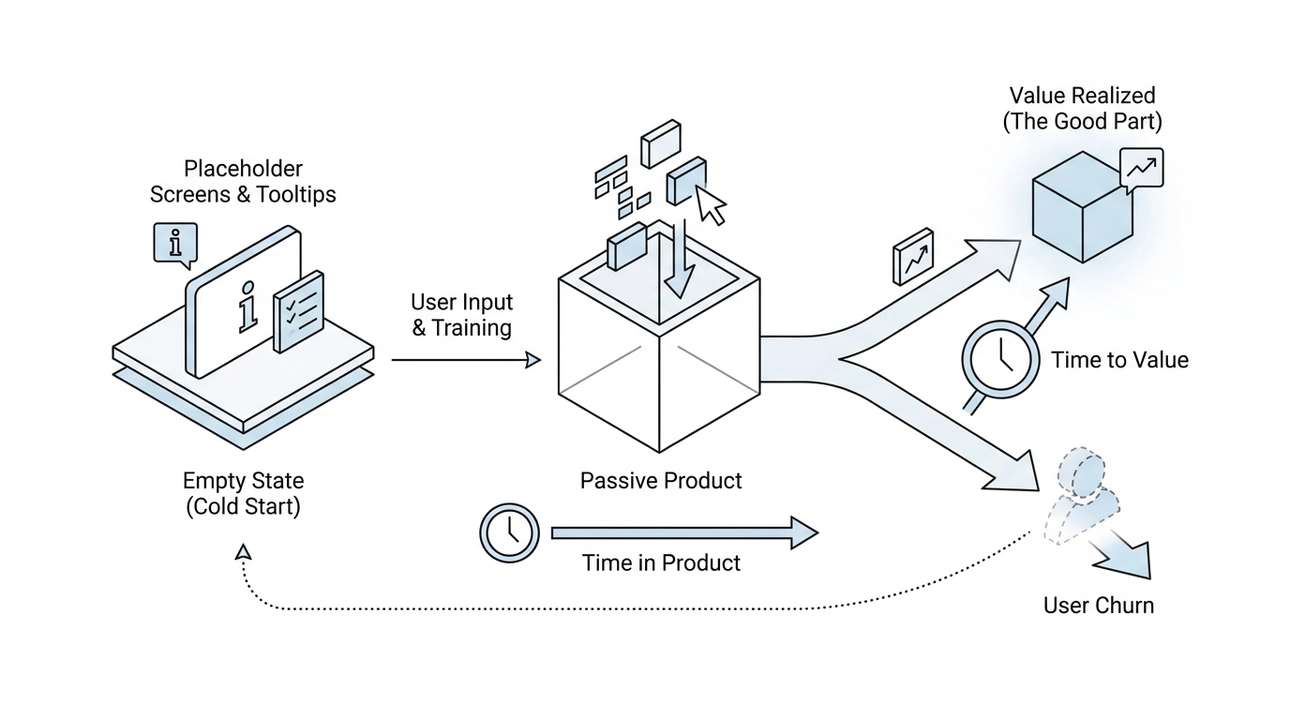
The deeper issue was never really about design craft. It was about the underlying assumption that a product only becomes useful after a user has trained it with enough behavior and input. The product was passive. It waited to learn. And users, in the meantime, had to tolerate a stripped-down version of the thing they were sold.
This is worth sitting with for a moment. In most software categories, whether that is CRM, project management, analytics, or marketing tools, the time to value has been directly tied to time in product. The more you use it, the better it gets. That sounds like a reasonable trade-off until you realize how many users churn before they ever get to the good part.
What Changes When AI Enters the Room
The shift that is happening now is not that AI makes products smarter over time. Products have been doing that for years with basic personalization engines and recommendation algorithms. The shift is that AI can compress the distance between day one and the moment a product starts to feel genuinely useful.

This works because modern AI systems can do something earlier approaches could not: they can make reasonable, context-aware inferences about a user before that user has done much of anything. They can draw on category-level behavior patterns, stated preferences from a brief onboarding exchange, the user's role, their industry, even the device and context they are coming from. The product does not need six months of usage data to make a first smart move. It needs enough signal to make a credible opening guess.
That distinction, between waiting to learn and making an informed first move, is where the user experience fundamentally changes. A product that greets a new marketing manager with a pre-populated dashboard relevant to campaign performance, rather than an empty canvas and a blinking cursor, is not just more pleasant to use. It is communicating something about its own intelligence and usefulness before a single feature has been clicked.
Across verticals and product categories, this pattern is becoming one of the clearest competitive differentiators available. Not which product has the most features, but which product makes a user feel capable and oriented from the moment they land. That feeling has real retention and activation implications, and it is one of the more underappreciated ways AI is reshaping product strategy.
Designing for a Product That Already Knows You
There is a design challenge embedded in all of this that does not get enough attention. If AI can make a product feel alive from day one, then the design language built around empty states, onboarding flows, and progressive disclosure needs to be rethought from the ground up.
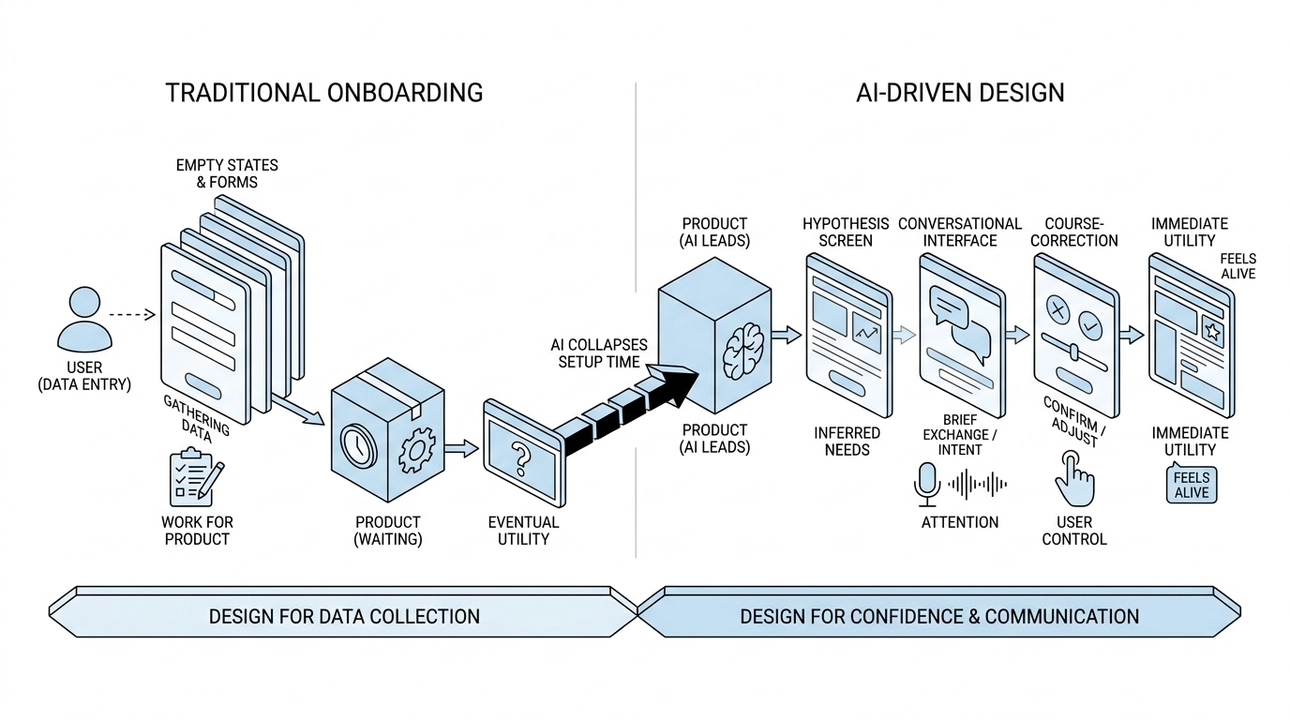
Onboarding was originally designed to buy the product time. The wizard, the checklist, the "complete your profile" prompt: all of these were mechanisms for gathering the data the product needed before it could be useful. They were, in a sense, the product asking the user to do work on its behalf. When AI collapses that setup time, the rationale for traditional onboarding collapses with it.
What replaces it is a different design philosophy, one where the product leads rather than waits. The first screen is not a blank slate the user has to populate. It is a hypothesis the product is already making about what this person needs. Designing for that requires thinking about how confidence is communicated, how inferences are surfaced without feeling presumptuous, and how users are given the ability to course-correct when the product's guess is off.
This is where conversational interfaces become genuinely useful, not as a novelty layer, but as a practical mechanism for closing the gap between what the product assumes and what the user actually wants. A brief exchange at the start of a session can surface intent and preference in a way that no form field or onboarding checklist ever could. It feels less like data collection and more like the product paying attention.
The products getting this right are not necessarily the ones with the most sophisticated AI under the hood. They are the ones with teams that understand this design shift clearly enough to build for it intentionally. That requires product leaders and designers to think differently about what "first use" means and what the experience of a product that already knows you should actually feel like.
The First Impression Is Now a Design Choice
There is a version of software that greets every new user the same way regardless of who they are, what they need, or what context they are arriving from. That version is becoming harder to defend.

The tools exist now to make a product feel considered and alive from the very first interaction. The question is whether teams are building around that possibility or still designing for the constraint of a world where cold starts were inevitable.
The empty state was never really about the absence of data. It was about the absence of intelligence applied early enough to matter. Closing that gap is not a backend problem anymore. It is a product and design problem, and the teams that treat it that way are the ones building experiences that earn trust before users even know why they trust it.
That is a different bar. And it is the one worth building toward.