The Manager-IC Convergence: How AI Is Collapsing the Line Between Leading and Doing

There was a time when the line between an individual contributor and a manager felt almost sacred. One role was about doing. The other was about enabling others to do. The two lived in different lanes, and the system worked, more or less, because the separation made sense.
That clarity is now quietly dissolving, and the organizations that understand what is happening next will have a significant advantage over those still drawing rigid org charts.
The Old Model Was Built on Scarcity
The traditional distinction between individual contributors and managers was, at its core, a solution to a resource problem. There is only so much one person can do. A senior engineer, a skilled designer, or an experienced product person could either spend their time building, or they could spend it directing others who build. Doing both at scale was impractical. So the system formalized the split: individual contributors own execution, managers own delegation, prioritization, stakeholder alignment, and review.

This model made sense when the tools available to any one person were roughly equivalent. A manager could review a PRD, but writing a thorough one from scratch still took hours. Generating a stakeholder report on churn and activation metrics still required pulling analysts into the loop. The friction of doing was high enough that staying in the managerial lane was not a choice, it was a necessity.
That friction is shrinking fast, and the implications for how teams are structured, how roles are defined, and how careers are built are only beginning to surface.
A New Kind of Professional Is Emerging
What is happening now is less of a role swap and more of a convergence. Managers are not becoming individual contributors again in the full sense, but they are reclaiming meaningful portions of the execution layer that were previously too costly to touch. At the same time, individual contributors are gaining access to capabilities that were once reserved for people with teams behind them, the ability to coordinate, synthesize, and deliver across multiple workstreams simultaneously.
The result is a new kind of professional. Call them an ICM, an individual contributor manager. Or call them the augmented contributor. The label matters less than the underlying shift. What defines this person is not that they wear two hats, exactly, but that the boundary between the hats has become porous in a way that was not possible before.
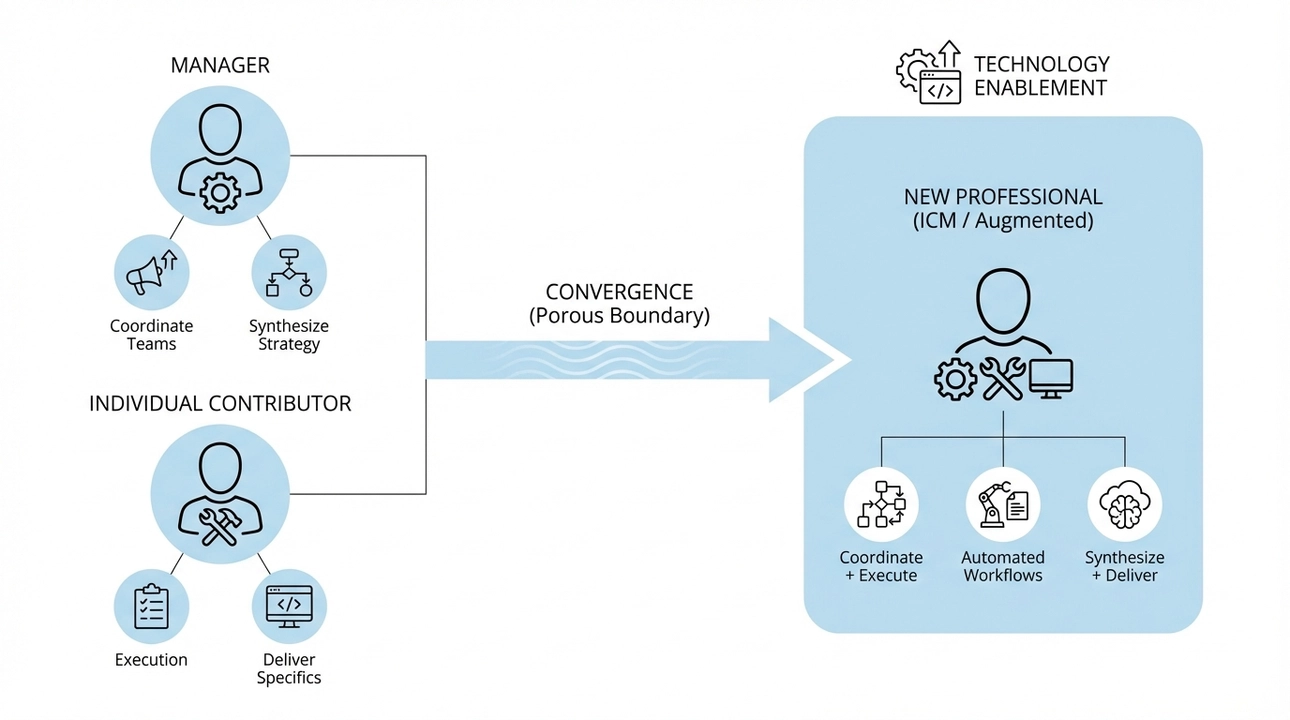
A product manager who previously relied on an analyst to pull together a weekly churn report can now point an agent at the same data sources and have a structured summary ready before the morning standup. A technical lead who once needed a writer to translate sprint changes into a polished changelog can now automate that output with a well-configured workflow. These are not trivial upgrades. They represent a fundamental change in what a single person, operating thoughtfully, can own and deliver.
What This Looks Like in Practice
The clearest signal of this shift shows up in the tasks that used to require delegation. The traditional managerial dependency chain, give a task to a report, wait for a draft, review, revise, re-review, was not inefficient because managers were bad at their jobs. It was inefficient because the cognitive and time cost of doing the work themselves was genuinely prohibitive.
That calculus is changing. Agents can now handle the first-pass creation of structured documents like product requirements, status updates, and technical summaries. They can monitor dashboards and surface anomalies without being asked. They can draft the changelog, the release note, the stakeholder email. The manager who once had to choose between doing and leading can increasingly do both, not by working longer hours, but by delegating differently.
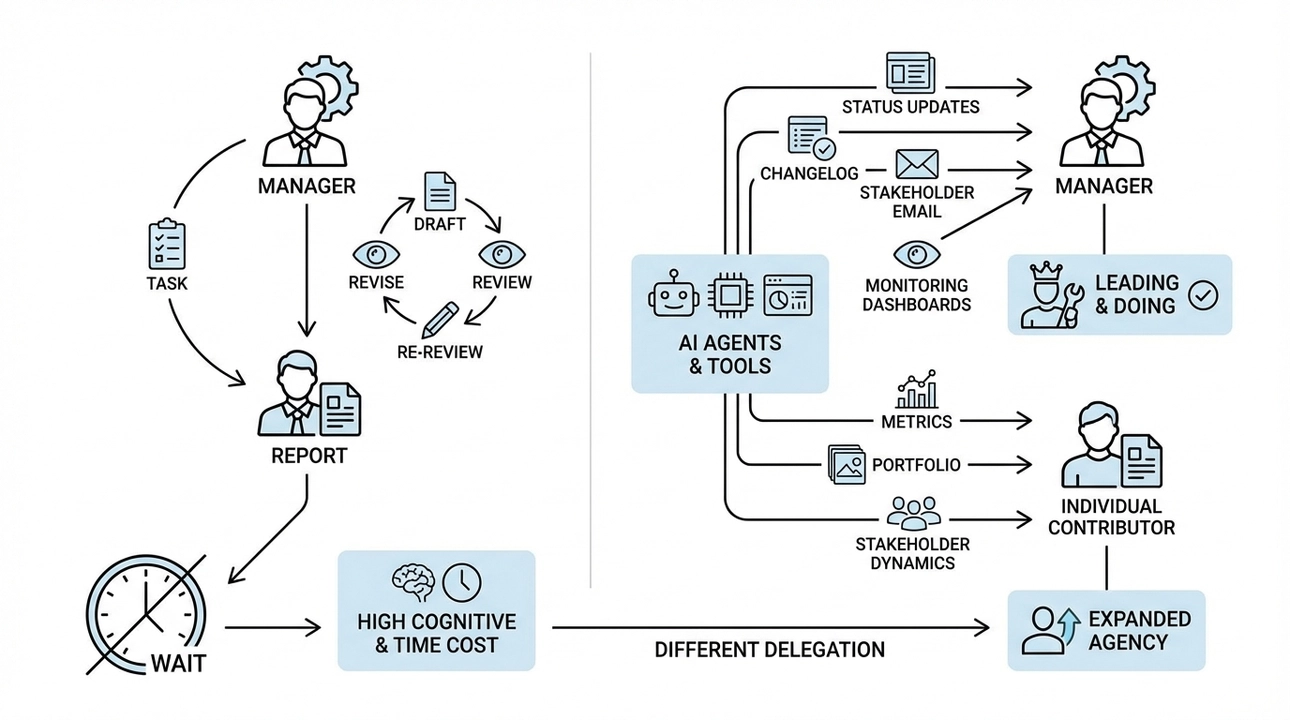
The interesting parallel is happening on the other side of the equation, too. Individual contributors who previously had little visibility into organizational context, the metrics that matter, the stakeholder dynamics, the broader portfolio picture, are now better equipped to operate with that context in hand. The tools that help a manager stay informed are the same tools that can help an IC make smarter decisions about their own work. The result is a quiet expansion of agency at every level of the team.
Why the Tech Sector Feels This First
This convergence is not happening uniformly across all industries. It is most visible, and most accelerated, in software, product, and design, and there are structural reasons for that. These disciplines already exist at the intersection of knowledge work and tooling. The people in these roles are predisposed to adopt new tools quickly, and the workflows they manage, documents, data, code, design files, communications, are already largely digital and therefore automatable.
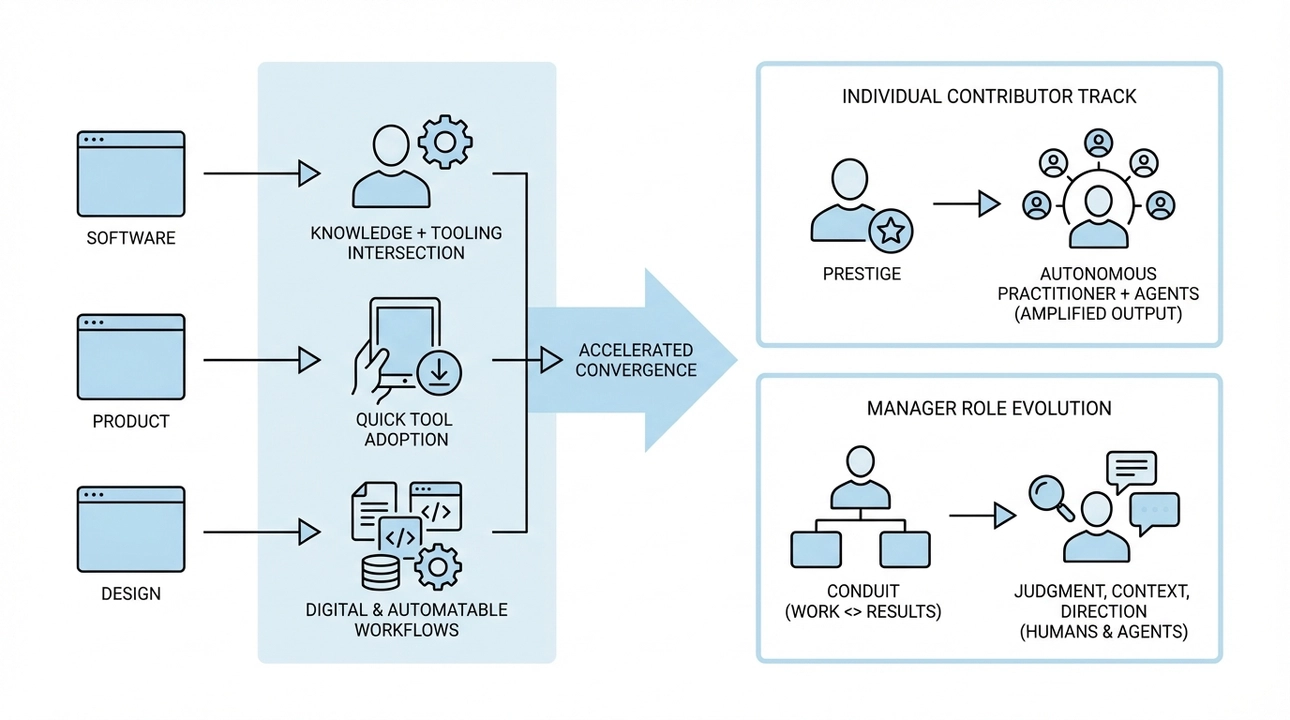
There is also a cultural dimension. In the tech sector, the individual contributor track has always carried a certain prestige. Senior engineers and staff designers often wield more influence than many managers. The idea that a skilled practitioner could operate at an even higher level of autonomy, with agents amplifying their output rather than requiring them to climb into a management role to gain leverage, is genuinely appealing. And it is now genuinely possible.
This does not mean the manager role disappears. What it does mean is that the value of a manager is increasingly less about being a conduit between work and results, and more about judgment, context, and the ability to ask the right questions of both humans and agents alike. The managers who thrive in this next phase will be the ones who understand what agents can do, how to direct them precisely, and when to trust the output versus when to dig deeper.
The Shape of Teams to Come
If individual contributors are gaining managerial leverage and managers are recovering execution capability, then the natural question is what this means for team structure. Flatter teams become more viable. Smaller pods with broader ownership become more attractive. The argument for large, layered hierarchies becomes harder to make when a well-equipped three-person team can do what previously required ten.

This is not a utopian prediction. There are real limits. Agents still require thoughtful direction. The judgment layer, knowing what to build, why, and for whom, remains deeply human. The nuanced stakeholder relationships that determine whether a product gets funded or a strategy gets adopted are not things that can be delegated to a workflow. The work that remains stubbornly human is often the work that matters most.
But the administrative and execution overhead that has always surrounded that human work is becoming thinner. And as it does, the professionals who learn to operate in this new dual mode, contributing with depth and leading with clarity, will carry an outsized advantage.
The Roles Worth Building Toward
The most interesting implication of all this is what it means for career development, especially for the next generation of practitioners entering the tech industry. The traditional ladder, IC to senior IC to manager to director, was always a simplification. It implied that leadership meant stepping back from the craft. That tradeoff is becoming optional in ways it never was before.
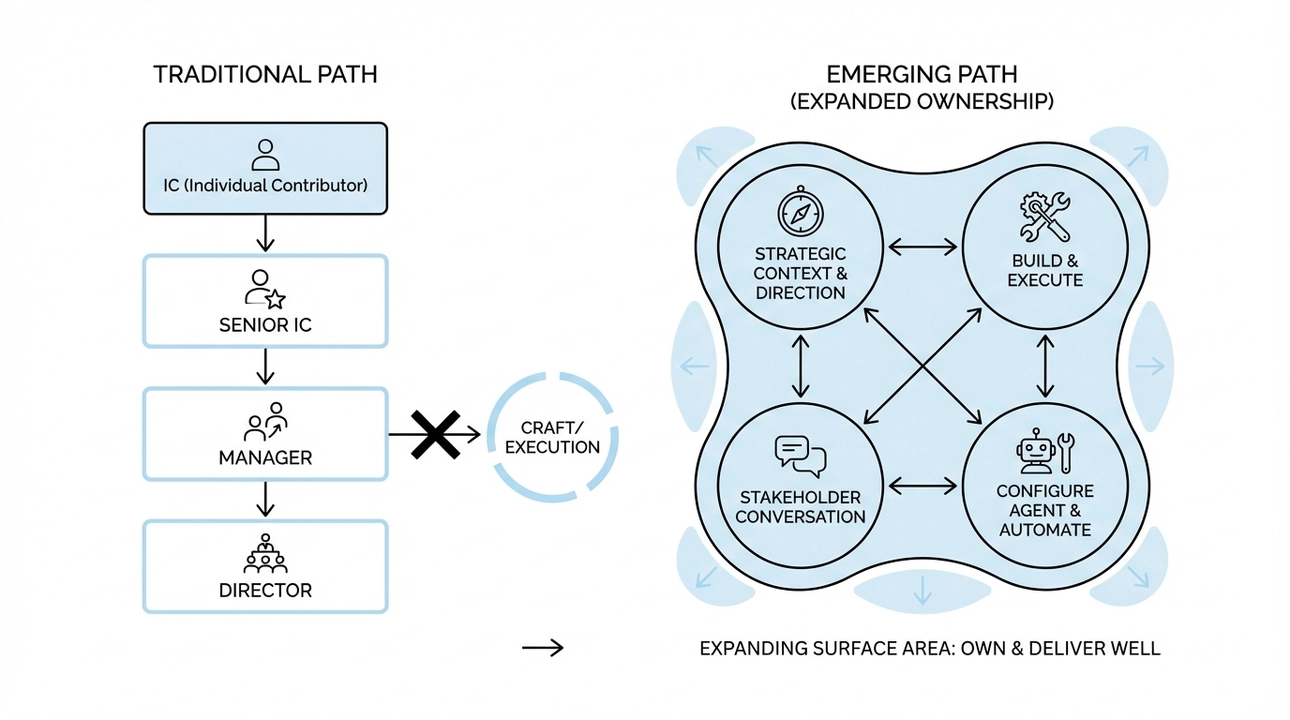
The emerging path is not linear in the same way. It is less about moving away from execution and more about expanding the surface area of what one person can own and deliver well. The professionals who will be most valuable are those who can hold strategic context and still get into the work, who can set direction and also build the thing, who can lead a conversation with a stakeholder and then go configure the agent that will automate the follow-up.
The Line Was Always Artificial
The distinction between individual contributor and manager was never quite as clean as the org chart suggested. Great managers never fully stopped contributing. Great senior ICs were always influencing direction, even without a formal report. What is changing now is not the underlying nature of good work, it is the infrastructure available to support it.
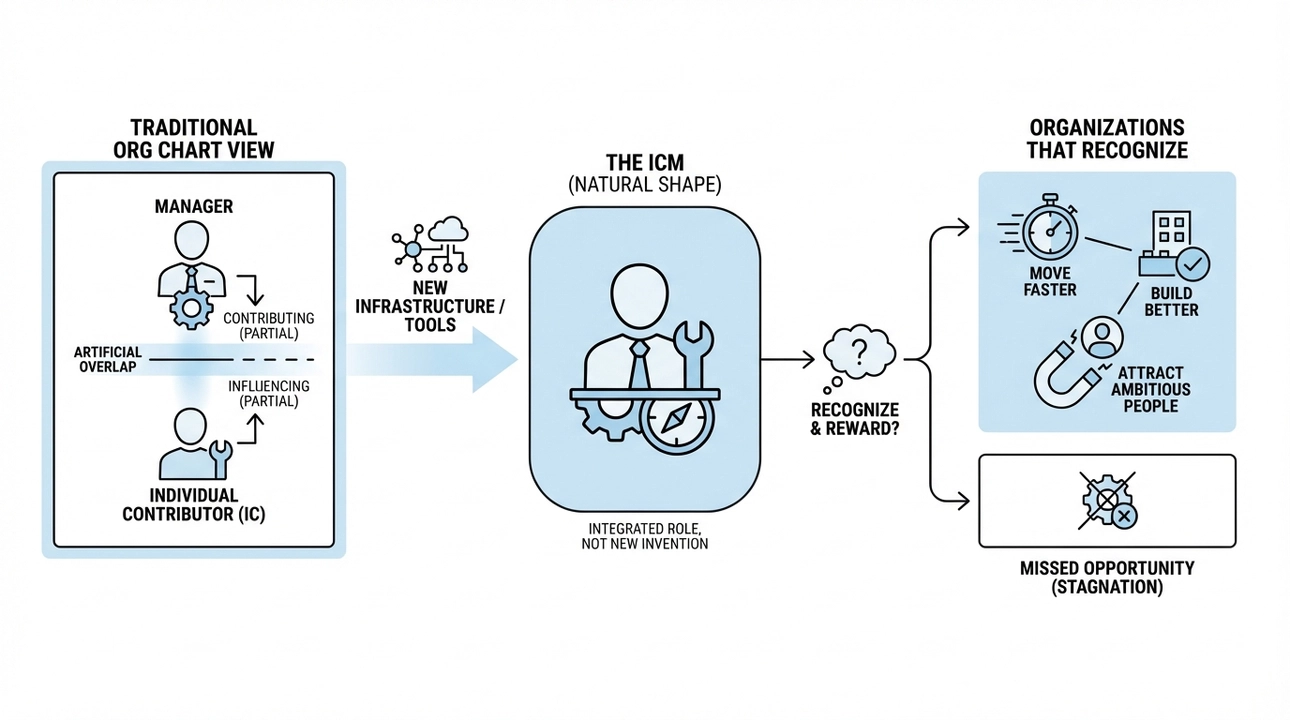
The ICM, whatever the name ultimately becomes, is not a new invention. It is the natural shape of an ambitious professional finally given tools that match their ambition. The question worth sitting with is not whether this role exists. It is whether the teams and organizations being built today are designed to recognize and reward it.
Those that are will move faster, build better, and attract the kind of people who want to do both.