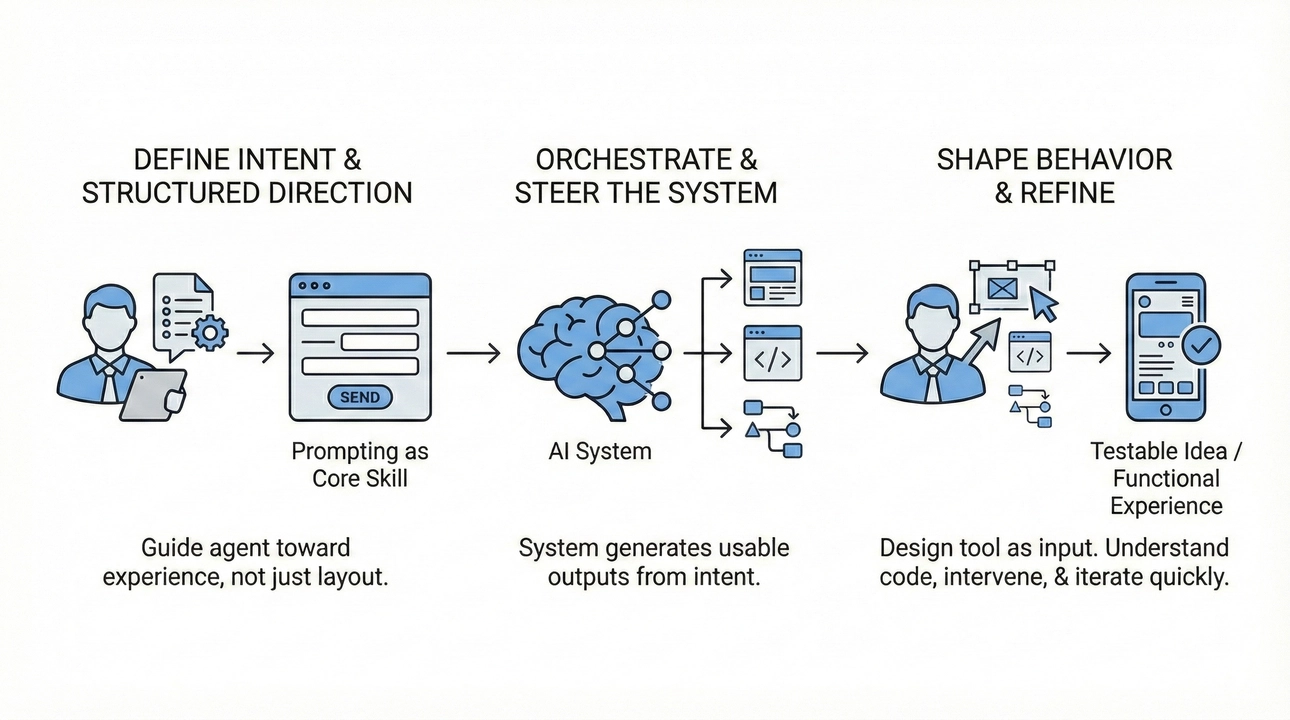
{"json":{"type":"doc","content":[{"type":"image","attrs":{"src":"https://server.onli.bio/files/onliweb/e0fbf099dd9d4a6e11ec4e36f7ae30cc_GeminiGeneratedImagel7kjcnl7kjcnl7kj.lg.webp","alt":null,"title":null,"caption":"The Future of Product/UX Designer Role","thumbnail":null}},{"type":"paragraph","content":[{"type":"text","text":"I stopped opening Figma as often as I used to."}]},{"type":"paragraph","content":[{"type":"text","text":"After spending the last few years deep in product design, building design systems, component libraries, and workflows, something shifted. In the past month or two, I’ve only opened Figma a handful of times. And when I do, it’s usually just to sketch an idea quickly so I can pass it as instruction to an AI design or coding tool."}]},{"type":"paragraph","content":[{"type":"text","text":"What used to take hours of manual work now takes minutes once intent is clear. That change is not about losing interest in design. It’s about where the work is moving."}]},{"type":"paragraph","content":[{"type":"text","text":"Design has always evolved alongside its tools. We started with ideas on paper. Then came digital canvases, stylus-driven workflows, desktop software, and eventually browser-based, cloud-native tools. Each shift didn’t eliminate designers. It changed what designers were responsible for."}]},{"type":"paragraph","content":[{"type":"text","text":"I believe we are now entering the next iteration of that evolution, especially in UX and UI. And it requires a new kind of role."}]},{"type":"paragraph"},{"type":"heading","attrs":{"level":3},"content":[{"type":"text","text":"The Evolution of Design Roles"}]},{"type":"paragraph","content":[{"type":"text","text":"If you look back 15 or 20 years, most digital experiences were created by graphic or visual designers. As the web matured, those roles shifted into web designers who worked closer to implementation. Over time, that split into UX designers, UI designers, and interaction designers. Eventually, many of those merged into what we now call product designers."}]},{"type":"image","attrs":{"src":"https://server.onli.bio/files/onliweb/b85beffefa34e232bbc073ab2aa723ab_GeminiGeneratedImagetn8h2ztn8h2ztn8h.lg.webp","alt":null,"title":null,"caption":"The Evolution of Design Roles (Web, Software, Apps, Product)","thumbnail":null}},{"type":"paragraph","content":[{"type":"text","text":"Each transition reflected increasing complexity and tighter coupling between design and technology."}]},{"type":"paragraph","content":[{"type":"text","text":"The next iteration follows the same pattern."}]},{"type":"paragraph","content":[{"type":"text","text":"Today, it’s possible to create real, interactive, working product concepts without going through long handoff cycles. Not static mockups, but functional experiences that behave like real applications. When you combine UX thinking, UI craft, and interaction design with an understanding of how systems work, you arrive at something new."}]},{"type":"paragraph","content":[{"type":"text","text":"That is what I call the design engineer."}]},{"type":"paragraph","content":[{"type":"text","text":"Not someone who replaces engineers. Not someone who codes everything by hand. But someone who understands how to shape intent, constraints, and behavior well enough that systems can generate, iterate, and refine experiences quickly."}]},{"type":"paragraph","content":[{"type":"text","text":"That role goes by several names already. Some teams call it a design engineer. Others use titles like UX engineer, design developer, product engineer, or even frontend product designer. The naming will continue to evolve, just as it did with UX and product design. "}]},{"type":"paragraph","content":[{"type":"text","text":"What matters is not the title, but the capability. Designers who can operate in this space will have disproportionate impact over the next few years."}]},{"type":"paragraph"},{"type":"heading","attrs":{"level":3},"content":[{"type":"text","text":"What the Design Engineer Actually Does"}]},{"type":"paragraph","content":[{"type":"text","text":"At its core, the design engineer role is about orchestration."}]},{"type":"paragraph","content":[{"type":"text","text":"Instead of manually building every screen, the design engineer defines intent clearly enough that AI systems can generate usable outputs. That intent is refined through selection, feedback, and additional instruction. You are no longer designing a single artifact. You are steering a system."}]},{"type":"image","attrs":{"src":"https://server.onli.bio/files/onliweb/eeba7e463adce6644a1b105de4ef3805_GeminiGeneratedImageoku7m4oku7m4oku7.lg.webp","alt":null,"title":null,"caption":" The Design Engineer Role and Function","thumbnail":null}},{"type":"paragraph","content":[{"type":"text","text":"Prompting becomes a core skill here, but not in a superficial sense. This isn’t about clever phrasing. It’s about structured direction. Design prompting means guiding an agent toward the right experience, not just the right layout. Think PRDs and user-stories."}]},{"type":"paragraph","content":[{"type":"text","text":"This also changes how designers relate to code. You don’t need to write everything line by line, but you do need to understand what the system is producing, how it behaves, and where to intervene. Selecting elements, asking for revisions, shaping behavior, and understanding constraints become part of the design process."}]},{"type":"paragraph","content":[{"type":"text","text":"In my own work, I now treat design tools as a way to express intent rather than a destination. Figma has become an input mechanism (on rare occasions), not the final workspace anymore. The real work happens in how quickly an idea becomes something testable."}]},{"type":"paragraph"},{"type":"heading","attrs":{"level":3},"content":[{"type":"text","text":"The Expanding Tooling Stack"}]},{"type":"paragraph","content":[{"type":"text","text":"This shift is being accelerated by a new generation of tools."}]},{"type":"paragraph","content":[{"type":"text","text":"On the entry and intermediate side, there are prompt-based, cloud tools that allow designers to experiment quickly. Tools like Vercel v0, Lovable, Replit, Bolt, and others let you describe what you want and iterate from there. They are not magic. They still require direction. But they dramatically lower the barrier to creating real concepts."}]},{"type":"image","attrs":{"src":"https://server.onli.bio/files/onliweb/5ff08a8540d7fb6f339f57f50e388b89_GeminiGeneratedImagei1hja7i1hja7i1hj.lg.webp","alt":null,"title":null,"caption":"The Stack of Design Engineers","thumbnail":null}},{"type":"paragraph","content":[{"type":"text","text":"The next layer is where designers start working closer to developer tooling. Editors like Cursor, Windsurf, and Copilot bring AI directly into environments where code runs locally. This is where I spend most of my time. You can talk to an agent, inspect code, make changes, and see results immediately. You gain far more control without needing to be a traditional engineer."}]},{"type":"paragraph","content":[{"type":"text","text":"There is also a deeper layer where engineers move toward design, working directly in terminals and infrastructure. Designers don’t need to live there, but understanding how the front end communicates with APIs and data systems is becoming increasingly valuable."}]},{"type":"paragraph","content":[{"type":"text","text":"What matters is not mastering every tool. It’s understanding how far down the stack you need to go to express intent clearly and validate ideas quickly."}]},{"type":"paragraph"},{"type":"heading","attrs":{"level":3},"content":[{"type":"text","text":"Why This Role Matters Now"}]},{"type":"paragraph","content":[{"type":"text","text":"The biggest shift is speed."}]},{"type":"paragraph","content":[{"type":"text","text":"You can now take an idea from a discovery session and turn it into a working prototype in hours. Not a concept deck. Not wireframes waiting for approval. A real, interactive experience that can be validated or killed quickly."}]},{"type":"paragraph","content":[{"type":"text","text":"The traditional flow of requirements, wireframes, visual design, handoff, and development is increasingly out of sync with what is now possible. Time to first usable version matters more than early polish. V0 beats concept."}]},{"type":"image","attrs":{"src":"https://server.onli.bio/files/onliweb/957761090212d563983c25eea23912d9_GeminiGeneratedImagen9k6rzn9k6rzn9k6.lg.webp","alt":null,"title":null,"caption":"Why the Design Engineer Role Matters now with AI Workflows","thumbnail":null}},{"type":"paragraph","content":[{"type":"text","text":"This also enables leaner teams. When fewer handoffs are required and validation happens earlier, waste is reduced. Designers stop working in isolation. Engineers stop building the wrong thing. Teams learn faster."}]},{"type":"paragraph","content":[{"type":"text","text":"This is also why I believe traditional tools like Figma are heading toward the same fate as earlier incumbents. It’s not the first time this has happened. Photoshop, Fireworks, Sketch and then Adobe XD once dominated until better workflows replaced them. Figma changed the paradigm with a cloud collaboration tool and pushed them out."}]},{"type":"paragraph","content":[{"type":"text","text":"AI-driven design and generation is doing the same thing now."}]},{"type":"paragraph","content":[{"type":"text","text":"This isn’t something to fear. It’s an opportunity to rethink how we work, relearn core skills, and rebuild workflows around speed, clarity, and feedback."}]},{"type":"paragraph"},{"type":"heading","attrs":{"level":3},"content":[{"type":"text","text":"Concluding thoughts"}]},{"type":"paragraph","content":[{"type":"text","text":"Every major shift in design follows a familiar arc. Tools change first. Roles adapt next. Value concentrates around those who evolve early."}]},{"type":"paragraph","content":[{"type":"text","text":"The design engineer is not a rejection of design craft. It is an expansion of it. Judgment still matters. Taste still matters. What changes is where that judgment is applied."}]},{"type":"image","attrs":{"src":"https://server.onli.bio/files/onliweb/3599423feec1d4501b361a236ae1356a_GeminiGeneratedImagenrgmqmnrgmqmnrgm.lg.webp","alt":null,"title":null,"caption":"The Future Designer Arc","thumbnail":null}},{"type":"paragraph","content":[{"type":"text","text":"Designers who learn to write intent, understand constraints, and orchestrate systems will design at a scale that manual workflows cannot match. They will move faster from idea to reality and make better decisions earlier."}]},{"type":"paragraph","content":[{"type":"text","text":"The future of UX is not that designers will code everything. Whether the role is called design engineer, UX engineer, design developer, or product engineer, the underlying shift is the same."}]},{"type":"paragraph","content":[{"type":"text","text":"It’s that designers will orchestrate code, systems, and AI with clarity and purpose."}]},{"type":"paragraph"},{"type":"paragraph","content":[{"type":"linkBlockNode","attrs":{"blockId":"1R8WcQoGDL","blockType":"subscribe","blockName":"Subscribe to Newsletter","block":"","pageId":"QqsMoT11Wd","isOwner":false}},{"type":"linkBlockNode","attrs":{"blockId":"IAWaoJUWun","blockType":"contact","blockName":"Send a Message","block":"","pageId":"QqsMoT11Wd","isOwner":false}}]},{"type":"horizontalRule"},{"type":"paragraph","content":[{"type":"text","marks":[{"type":"bold"}],"text":"Continue reading..."}]},{"type":"paragraph","content":[{"type":"linkBlockNode","attrs":{"blockId":"GyBKn8pmXY","blockType":"post","blockName":"Beginning the Year With Intention: Balancing Pace, Presence, and People","block":"","pageId":"QqsMoT11Wd","isOwner":false}},{"type":"linkBlockNode","attrs":{"blockId":"RZO79xsL7O","blockType":"post","blockName":"From Websites to Voice: The Real Problem We Discovered While Building Onliweb","block":"","pageId":"QqsMoT11Wd","isOwner":false}}]},{"type":"paragraph","content":[{"type":"linkBlockNode","attrs":{"blockId":"LzQE1EVFCA","blockType":"post","blockName":"Harnessing In-house Innovation: Building AI-Driven Teams for Future Success","block":"","pageId":"QqsMoT11Wd","isOwner":false}},{"type":"linkBlockNode","attrs":{"blockId":"ofhCh71VM1","blockType":"post","blockName":"Charting the Path to Singularity: Exploration, Documentation, and the Agentic Future","block":"","pageId":"QqsMoT11Wd","isOwner":false}}]},{"type":"paragraph"}]},"len":7060,"title":"The Rise of the Design Engineer: Why UX Is Entering Its Next Iteration","slug":"the-rise-of-the-design-engineer-why-ux-is-entering-its-next-iteration","lastSave":1770442666153,"shere":false,"showPublishedDate":true,"showShareOptions":true,"text":"\n\nI stopped opening Figma as often as I used to.\n\nAfter spending the last few years deep in product design, building design systems, component libraries, and workflows, something shifted. In the past month or two, I’ve only opened Figma a handful of times. And when I do, it’s usually just to sketch an idea quickly so I can pass it as instruction to an AI design or coding tool.\n\nWhat used to take hours of manual work now takes minutes once intent is clear. That change is not about losing interest in design. It’s about where the work is moving.\n\nDesign has always evolved alongside its tools. We started with ideas on paper. Then came digital canvases, stylus-driven workflows, desktop software, and eventually browser-based, cloud-native tools. Each shift didn’t eliminate designers. It changed what designers were responsible for.\n\nI believe we are now entering the next iteration of that evolution, especially in UX and UI. And it requires a new kind of role.\n\n\n\nThe Evolution of Design Roles\n\nIf you look back 15 or 20 years, most digital experiences were created by graphic or visual designers. As the web matured, those roles shifted into web designers who worked closer to implementation. Over time, that split into UX designers, UI designers, and interaction designers. Eventually, many of those merged into what we now call product designers.\n\n\n\nEach transition reflected increasing complexity and tighter coupling between design and technology.\n\nThe next iteration follows the same pattern.\n\nToday, it’s possible to create real, interactive, working product concepts without going through long handoff cycles. Not static mockups, but functional experiences that behave like real applications. When you combine UX thinking, UI craft, and interaction design with an understanding of how systems work, you arrive at something new.\n\nThat is what I call the design engineer.\n\nNot someone who replaces engineers. Not someone who codes everything by hand. But someone who understands how to shape intent, constraints, and behavior well enough that systems can generate, iterate, and refine experiences quickly.\n\nThat role goes by several names already. Some teams call it a design engineer. Others use titles like UX engineer, design developer, product engineer, or even frontend product designer. The naming will continue to evolve, just as it did with UX and product design. \n\nWhat matters is not the title, but the capability. Designers who can operate in this space will have disproportionate impact over the next few years.\n\n\n\nWhat the Design Engineer Actually Does\n\nAt its core, the design engineer role is about orchestration.\n\nInstead of manually building every screen, the design engineer defines intent clearly enough that AI systems can generate usable outputs. That intent is refined through selection, feedback, and additional instruction. You are no longer designing a single artifact. You are steering a system.\n\n\n\nPrompting becomes a core skill here, but not in a superficial sense. This isn’t about clever phrasing. It’s about structured direction. Design prompting means guiding an agent toward the right experience, not just the right layout. Think PRDs and user-stories.\n\nThis also changes how designers relate to code. You don’t need to write everything line by line, but you do need to understand what the system is producing, how it behaves, and where to intervene. Selecting elements, asking for revisions, shaping behavior, and understanding constraints become part of the design process.\n\nIn my own work, I now treat design tools as a way to express intent rather than a destination. Figma has become an input mechanism (on rare occasions), not the final workspace anymore. The real work happens in how quickly an idea becomes something testable.\n\n\n\nThe Expanding Tooling Stack\n\nThis shift is being accelerated by a new generation of tools.\n\nOn the entry and intermediate side, there are prompt-based, cloud tools that allow designers to experiment quickly. Tools like Vercel v0, Lovable, Replit, Bolt, and others let you describe what you want and iterate from there. They are not magic. They still require direction. But they dramatically lower the barrier to creating real concepts.\n\n\n\nThe next layer is where designers start working closer to developer tooling. Editors like Cursor, Windsurf, and Copilot bring AI directly into environments where code runs locally. This is where I spend most of my time. You can talk to an agent, inspect code, make changes, and see results immediately. You gain far more control without needing to be a traditional engineer.\n\nThere is also a deeper layer where engineers move toward design, working directly in terminals and infrastructure. Designers don’t need to live there, but understanding how the front end communicates with APIs and data systems is becoming increasingly valuable.\n\nWhat matters is not mastering every tool. It’s understanding how far down the stack you need to go to express intent clearly and validate ideas quickly.\n\n\n\nWhy This Role Matters Now\n\nThe biggest shift is speed.\n\nYou can now take an idea from a discovery session and turn it into a working prototype in hours. Not a concept deck. Not wireframes waiting for approval. A real, interactive experience that can be validated or killed quickly.\n\nThe traditional flow of requirements, wireframes, visual design, handoff, and development is increasingly out of sync with what is now possible. Time to first usable version matters more than early polish. V0 beats concept.\n\n\n\nThis also enables leaner teams. When fewer handoffs are required and validation happens earlier, waste is reduced. Designers stop working in isolation. Engineers stop building the wrong thing. Teams learn faster.\n\nThis is also why I believe traditional tools like Figma are heading toward the same fate as earlier incumbents. It’s not the first time this has happened. Photoshop, Fireworks, Sketch and then Adobe XD once dominated until better workflows replaced them. Figma changed the paradigm with a cloud collaboration tool and pushed them out.\n\nAI-driven design and generation is doing the same thing now.\n\nThis isn’t something to fear. It’s an opportunity to rethink how we work, relearn core skills, and rebuild workflows around speed, clarity, and feedback.\n\n\n\nConcluding thoughts\n\nEvery major shift in design follows a familiar arc. Tools change first. Roles adapt next. Value concentrates around those who evolve early.\n\nThe design engineer is not a rejection of design craft. It is an expansion of it. Judgment still matters. Taste still matters. What changes is where that judgment is applied.\n\n\n\nDesigners who learn to write intent, understand constraints, and orchestrate systems will design at a scale that manual workflows cannot match. They will move faster from idea to reality and make better decisions earlier.\n\nThe future of UX is not that designers will code everything. Whether the role is called design engineer, UX engineer, design developer, or product engineer, the underlying shift is the same.\n\nIt’s that designers will orchestrate code, systems, and AI with clarity and purpose.\n\n\n\n\n\n\n\nContinue reading...\n\n\n\n\n\n","html":"<img src=\"https://server.onli.bio/files/onliweb/e0fbf099dd9d4a6e11ec4e36f7ae30cc_GeminiGeneratedImagel7kjcnl7kjcnl7kj.lg.webp\" data-caption=\"The Future of Product/UX Designer Role\"><p class=\"text-sm font-normal leading-normal mt-1 mb-2\">I stopped opening Figma as often as I used to.</p><p class=\"text-sm font-normal leading-normal mt-1 mb-2\">After spending the last few years deep in product design, building design systems, component libraries, and workflows, something shifted. In the past month or two, I’ve only opened Figma a handful of times. And when I do, it’s usually just to sketch an idea quickly so I can pass it as instruction to an AI design or coding tool.</p><p class=\"text-sm font-normal leading-normal mt-1 mb-2\">What used to take hours of manual work now takes minutes once intent is clear. That change is not about losing interest in design. It’s about where the work is moving.</p><p class=\"text-sm font-normal leading-normal mt-1 mb-2\">Design has always evolved alongside its tools. We started with ideas on paper. Then came digital canvases, stylus-driven workflows, desktop software, and eventually browser-based, cloud-native tools. Each shift didn’t eliminate designers. It changed what designers were responsible for.</p><p class=\"text-sm font-normal leading-normal mt-1 mb-2\">I believe we are now entering the next iteration of that evolution, especially in UX and UI. And it requires a new kind of role.</p><p class=\"text-sm font-normal leading-normal mt-1 mb-2\"></p><h3>The Evolution of Design Roles</h3><p class=\"text-sm font-normal leading-normal mt-1 mb-2\">If you look back 15 or 20 years, most digital experiences were created by graphic or visual designers. As the web matured, those roles shifted into web designers who worked closer to implementation. Over time, that split into UX designers, UI designers, and interaction designers. Eventually, many of those merged into what we now call product designers.</p><img src=\"https://server.onli.bio/files/onliweb/b85beffefa34e232bbc073ab2aa723ab_GeminiGeneratedImagetn8h2ztn8h2ztn8h.lg.webp\" data-caption=\"The Evolution of Design Roles (Web, Software, Apps, Product)\"><p class=\"text-sm font-normal leading-normal mt-1 mb-2\">Each transition reflected increasing complexity and tighter coupling between design and technology.</p><p class=\"text-sm font-normal leading-normal mt-1 mb-2\">The next iteration follows the same pattern.</p><p class=\"text-sm font-normal leading-normal mt-1 mb-2\">Today, it’s possible to create real, interactive, working product concepts without going through long handoff cycles. Not static mockups, but functional experiences that behave like real applications. When you combine UX thinking, UI craft, and interaction design with an understanding of how systems work, you arrive at something new.</p><p class=\"text-sm font-normal leading-normal mt-1 mb-2\">That is what I call the design engineer.</p><p class=\"text-sm font-normal leading-normal mt-1 mb-2\">Not someone who replaces engineers. Not someone who codes everything by hand. But someone who understands how to shape intent, constraints, and behavior well enough that systems can generate, iterate, and refine experiences quickly.</p><p class=\"text-sm font-normal leading-normal mt-1 mb-2\">That role goes by several names already. Some teams call it a design engineer. Others use titles like UX engineer, design developer, product engineer, or even frontend product designer. The naming will continue to evolve, just as it did with UX and product design. </p><p class=\"text-sm font-normal leading-normal mt-1 mb-2\">What matters is not the title, but the capability. Designers who can operate in this space will have disproportionate impact over the next few years.</p><p class=\"text-sm font-normal leading-normal mt-1 mb-2\"></p><h3>What the Design Engineer Actually Does</h3><p class=\"text-sm font-normal leading-normal mt-1 mb-2\">At its core, the design engineer role is about orchestration.</p><p class=\"text-sm font-normal leading-normal mt-1 mb-2\">Instead of manually building every screen, the design engineer defines intent clearly enough that AI systems can generate usable outputs. That intent is refined through selection, feedback, and additional instruction. You are no longer designing a single artifact. You are steering a system.</p><img src=\"https://server.onli.bio/files/onliweb/eeba7e463adce6644a1b105de4ef3805_GeminiGeneratedImageoku7m4oku7m4oku7.lg.webp\" data-caption=\" The Design Engineer Role and Function\"><p class=\"text-sm font-normal leading-normal mt-1 mb-2\">Prompting becomes a core skill here, but not in a superficial sense. This isn’t about clever phrasing. It’s about structured direction. Design prompting means guiding an agent toward the right experience, not just the right layout. Think PRDs and user-stories.</p><p class=\"text-sm font-normal leading-normal mt-1 mb-2\">This also changes how designers relate to code. You don’t need to write everything line by line, but you do need to understand what the system is producing, how it behaves, and where to intervene. Selecting elements, asking for revisions, shaping behavior, and understanding constraints become part of the design process.</p><p class=\"text-sm font-normal leading-normal mt-1 mb-2\">In my own work, I now treat design tools as a way to express intent rather than a destination. Figma has become an input mechanism (on rare occasions), not the final workspace anymore. The real work happens in how quickly an idea becomes something testable.</p><p class=\"text-sm font-normal leading-normal mt-1 mb-2\"></p><h3>The Expanding Tooling Stack</h3><p class=\"text-sm font-normal leading-normal mt-1 mb-2\">This shift is being accelerated by a new generation of tools.</p><p class=\"text-sm font-normal leading-normal mt-1 mb-2\">On the entry and intermediate side, there are prompt-based, cloud tools that allow designers to experiment quickly. Tools like Vercel v0, Lovable, Replit, Bolt, and others let you describe what you want and iterate from there. They are not magic. They still require direction. But they dramatically lower the barrier to creating real concepts.</p><img src=\"https://server.onli.bio/files/onliweb/5ff08a8540d7fb6f339f57f50e388b89_GeminiGeneratedImagei1hja7i1hja7i1hj.lg.webp\" data-caption=\"The Stack of Design Engineers\"><p class=\"text-sm font-normal leading-normal mt-1 mb-2\">The next layer is where designers start working closer to developer tooling. Editors like Cursor, Windsurf, and Copilot bring AI directly into environments where code runs locally. This is where I spend most of my time. You can talk to an agent, inspect code, make changes, and see results immediately. You gain far more control without needing to be a traditional engineer.</p><p class=\"text-sm font-normal leading-normal mt-1 mb-2\">There is also a deeper layer where engineers move toward design, working directly in terminals and infrastructure. Designers don’t need to live there, but understanding how the front end communicates with APIs and data systems is becoming increasingly valuable.</p><p class=\"text-sm font-normal leading-normal mt-1 mb-2\">What matters is not mastering every tool. It’s understanding how far down the stack you need to go to express intent clearly and validate ideas quickly.</p><p class=\"text-sm font-normal leading-normal mt-1 mb-2\"></p><h3>Why This Role Matters Now</h3><p class=\"text-sm font-normal leading-normal mt-1 mb-2\">The biggest shift is speed.</p><p class=\"text-sm font-normal leading-normal mt-1 mb-2\">You can now take an idea from a discovery session and turn it into a working prototype in hours. Not a concept deck. Not wireframes waiting for approval. A real, interactive experience that can be validated or killed quickly.</p><p class=\"text-sm font-normal leading-normal mt-1 mb-2\">The traditional flow of requirements, wireframes, visual design, handoff, and development is increasingly out of sync with what is now possible. Time to first usable version matters more than early polish. V0 beats concept.</p><img src=\"https://server.onli.bio/files/onliweb/957761090212d563983c25eea23912d9_GeminiGeneratedImagen9k6rzn9k6rzn9k6.lg.webp\" data-caption=\"Why the Design Engineer Role Matters now with AI Workflows\"><p class=\"text-sm font-normal leading-normal mt-1 mb-2\">This also enables leaner teams. When fewer handoffs are required and validation happens earlier, waste is reduced. Designers stop working in isolation. Engineers stop building the wrong thing. Teams learn faster.</p><p class=\"text-sm font-normal leading-normal mt-1 mb-2\">This is also why I believe traditional tools like Figma are heading toward the same fate as earlier incumbents. It’s not the first time this has happened. Photoshop, Fireworks, Sketch and then Adobe XD once dominated until better workflows replaced them. Figma changed the paradigm with a cloud collaboration tool and pushed them out.</p><p class=\"text-sm font-normal leading-normal mt-1 mb-2\">AI-driven design and generation is doing the same thing now.</p><p class=\"text-sm font-normal leading-normal mt-1 mb-2\">This isn’t something to fear. It’s an opportunity to rethink how we work, relearn core skills, and rebuild workflows around speed, clarity, and feedback.</p><p class=\"text-sm font-normal leading-normal mt-1 mb-2\"></p><h3>Concluding thoughts</h3><p class=\"text-sm font-normal leading-normal mt-1 mb-2\">Every major shift in design follows a familiar arc. Tools change first. Roles adapt next. Value concentrates around those who evolve early.</p><p class=\"text-sm font-normal leading-normal mt-1 mb-2\">The design engineer is not a rejection of design craft. It is an expansion of it. Judgment still matters. Taste still matters. What changes is where that judgment is applied.</p><img src=\"https://server.onli.bio/files/onliweb/3599423feec1d4501b361a236ae1356a_GeminiGeneratedImagenrgmqmnrgmqmnrgm.lg.webp\" data-caption=\"The Future Designer Arc\"><p class=\"text-sm font-normal leading-normal mt-1 mb-2\">Designers who learn to write intent, understand constraints, and orchestrate systems will design at a scale that manual workflows cannot match. They will move faster from idea to reality and make better decisions earlier.</p><p class=\"text-sm font-normal leading-normal mt-1 mb-2\">The future of UX is not that designers will code everything. Whether the role is called design engineer, UX engineer, design developer, or product engineer, the underlying shift is the same.</p><p class=\"text-sm font-normal leading-normal mt-1 mb-2\">It’s that designers will orchestrate code, systems, and AI with clarity and purpose.</p><p class=\"text-sm font-normal leading-normal mt-1 mb-2\"></p><p class=\"text-sm font-normal leading-normal mt-1 mb-2\"><span blockid=\"1R8WcQoGDL\" blocktype=\"subscribe\" blockname=\"Subscribe to Newsletter\" block=\"\" pageid=\"QqsMoT11Wd\" isowner=\"false\" data-link-block-node=\"\" class=\"node-linkBlockNode\"></span><span blockid=\"IAWaoJUWun\" blocktype=\"contact\" blockname=\"Send a Message\" block=\"\" pageid=\"QqsMoT11Wd\" isowner=\"false\" data-link-block-node=\"\" class=\"node-linkBlockNode\"></span></p><hr class=\"mt-4 mb-6 border-t border-gray-200 dark:border-neutral-700\"><p class=\"text-sm font-normal leading-normal mt-1 mb-2\"><strong>Continue reading...</strong></p><p class=\"text-sm font-normal leading-normal mt-1 mb-2\"><span blockid=\"GyBKn8pmXY\" blocktype=\"post\" blockname=\"Beginning the Year With Intention: Balancing Pace, Presence, and People\" block=\"\" pageid=\"QqsMoT11Wd\" isowner=\"false\" data-link-block-node=\"\" class=\"node-linkBlockNode\"></span><span blockid=\"RZO79xsL7O\" blocktype=\"post\" blockname=\"From Websites to Voice: The Real Problem We Discovered While Building Onliweb\" block=\"\" pageid=\"QqsMoT11Wd\" isowner=\"false\" data-link-block-node=\"\" class=\"node-linkBlockNode\"></span></p><p class=\"text-sm font-normal leading-normal mt-1 mb-2\"><span blockid=\"LzQE1EVFCA\" blocktype=\"post\" blockname=\"Harnessing In-house Innovation: Building AI-Driven Teams for Future Success\" block=\"\" pageid=\"QqsMoT11Wd\" isowner=\"false\" data-link-block-node=\"\" class=\"node-linkBlockNode\"></span><span blockid=\"ofhCh71VM1\" blocktype=\"post\" blockname=\"Charting the Path to Singularity: Exploration, Documentation, and the Agentic Future\" block=\"\" pageid=\"QqsMoT11Wd\" isowner=\"false\" data-link-block-node=\"\" class=\"node-linkBlockNode\"></span></p><p class=\"text-sm font-normal leading-normal mt-1 mb-2\"></p>","style":"preview","access":"public"}