When AI Agents Start Managing People: The Shift Nobody Is Talking About Yet

There is a moment that keeps repeating itself across teams building with modern software. Someone sets up an autonomous agent to handle a workflow, a queue, a decision pipeline. And then, quietly, almost imperceptibly, the agent stops being a tool and starts being a layer. It starts sitting between people and their problems. That shift is easy to miss, because it does not announce itself. But it is the most consequential thing happening in how work gets done right now.
Most conversations about autonomous agents focus on what they can do: automate tasks, generate content, summarize data, route requests. All of that is real and useful. But the more interesting question is what happens to people when agents start doing those things consistently, reliably, at scale. What changes about how teams operate, how decisions get made, and how leaders lead?
From Tools to Infrastructure
For most of software history, tools did what you told them to do. They had no memory of yesterday, no opinion on tomorrow, and no ability to act without a direct command. The relationship was transactional and completely human-directed.
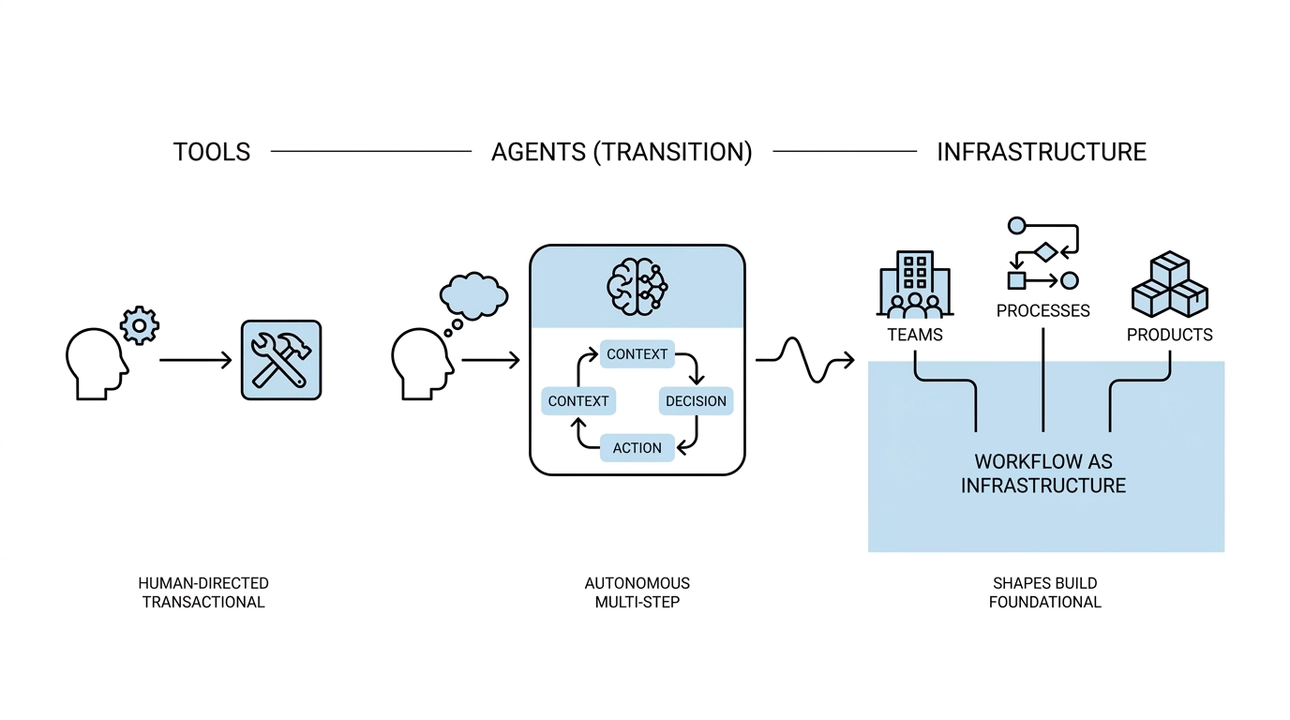
Autonomous agents break that model in a fundamental way. They do not wait for instructions on every step. They hold context, make intermediate decisions, and complete chains of work that used to require a person to be present at each link. That sounds like efficiency, and it is. But it is also something more structural.
When an agent consistently handles a workflow, that workflow stops being something a person thinks about actively. It becomes infrastructure. And just like cloud infrastructure or payment rails, once something becomes infrastructure, it shapes everything built on top of it. The teams, processes, and products that form around reliable autonomous agents will look very different from those that existed before them.
In vertical SaaS environments, this is already visible. Agents embedded in operational workflows are not just saving time. They are changing what skills matter, what meetings need to happen, and what decisions actually require a human. The tool has become a participant in how the organization runs.
The Problem With Passive Adoption
Here is where it gets complicated. Most teams are not making conscious decisions about which parts of their work to hand to agents. They are adopting capabilities as they become available, integrating them into existing workflows, and moving on. That is understandable. The pressure to ship, to grow, and to stay competitive does not leave much room for philosophical reflection on what automation means for team dynamics.
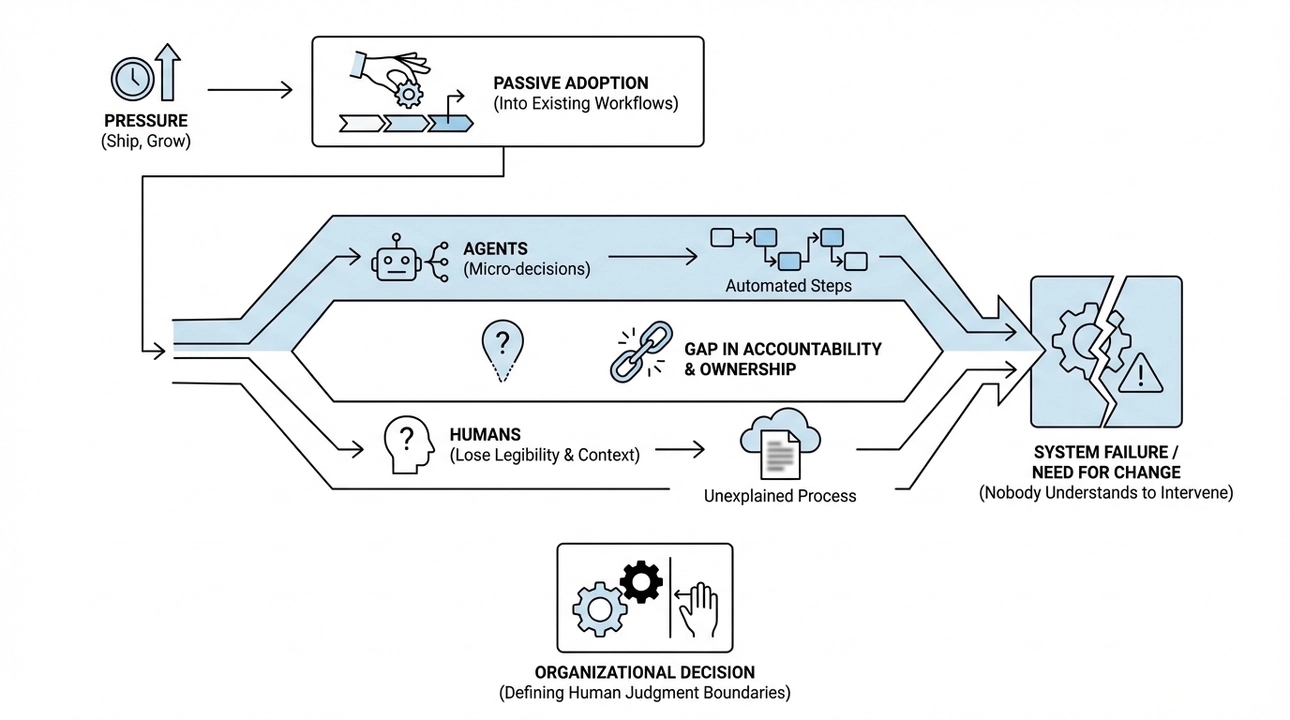
But passive adoption creates a specific kind of risk. When agents make enough micro-decisions inside a workflow, the humans in that workflow can lose legibility. They stop being able to explain why a process works the way it does, because they were never the ones running it. They lose the context that makes good judgment possible. And when something breaks, or needs to change, or needs to be questioned, there is nobody who actually understands the system well enough to intervene.
This is not a hypothetical. It is a pattern that shows up when autonomous systems are deployed without intentional ownership. The agent is not at fault. The gap in thinking about who remains accountable and who retains understanding is what creates the problem.
For founders and product leaders, this points to something important. Building with agents is not just a technical decision. It is an organizational one. Every workflow handed to an autonomous system is also a decision about where human judgment will and will not be exercised. Getting that boundary right matters more than it might initially seem.
What Thoughtful Agent Deployment Actually Looks Like
The teams getting this right share a few common traits. They are not avoiding agents out of fear, and they are not deploying them indiscriminately out of excitement. They are making deliberate choices about which kinds of decisions benefit from automation and which ones need to stay human.
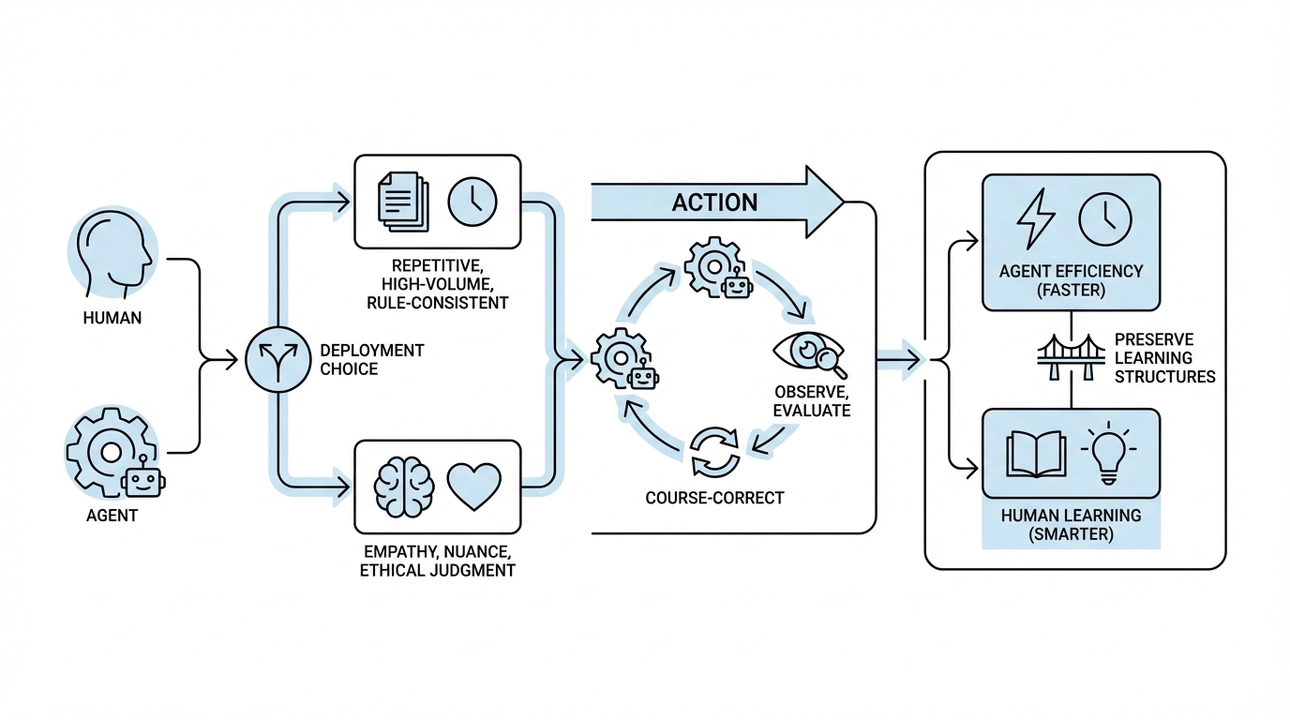
Repetitive, high-volume, rule-consistent workflows are good candidates for agents. Tasks where context accumulates faster than a human can process it are good candidates. Decisions that require empathy, nuance, ethical judgment, or relationship context are not good candidates, at least not for full autonomy.
The more important insight is that thoughtful deployment is also about feedback loops. When an agent makes a decision or takes an action, there should be a mechanism for humans to observe, evaluate, and course-correct. Not because agents will necessarily get it wrong, but because the humans working alongside them need to stay sharp. The moment an agent handles a category of decision so completely that no human is watching, that is the moment the organization loses the ability to meaningfully improve or question it.
There is also a deeper point about what autonomous agents do to organizational learning. When a person completes a task, they build intuition. They notice patterns, develop judgment, carry that forward. When an agent completes the same task thousands of times, the intuition accumulates somewhere that is not accessible to the team. The organization gets faster but not necessarily smarter. Building structures that preserve human learning alongside agent efficiency is one of the real design challenges of this moment.
The Question Worth Sitting With
The most productive frame for thinking about autonomous agents is not "what can we automate" but "what do we want to remain human, and why." That question does not have a universal answer. It depends on the product, the team, the context, and the values at the center of the work.
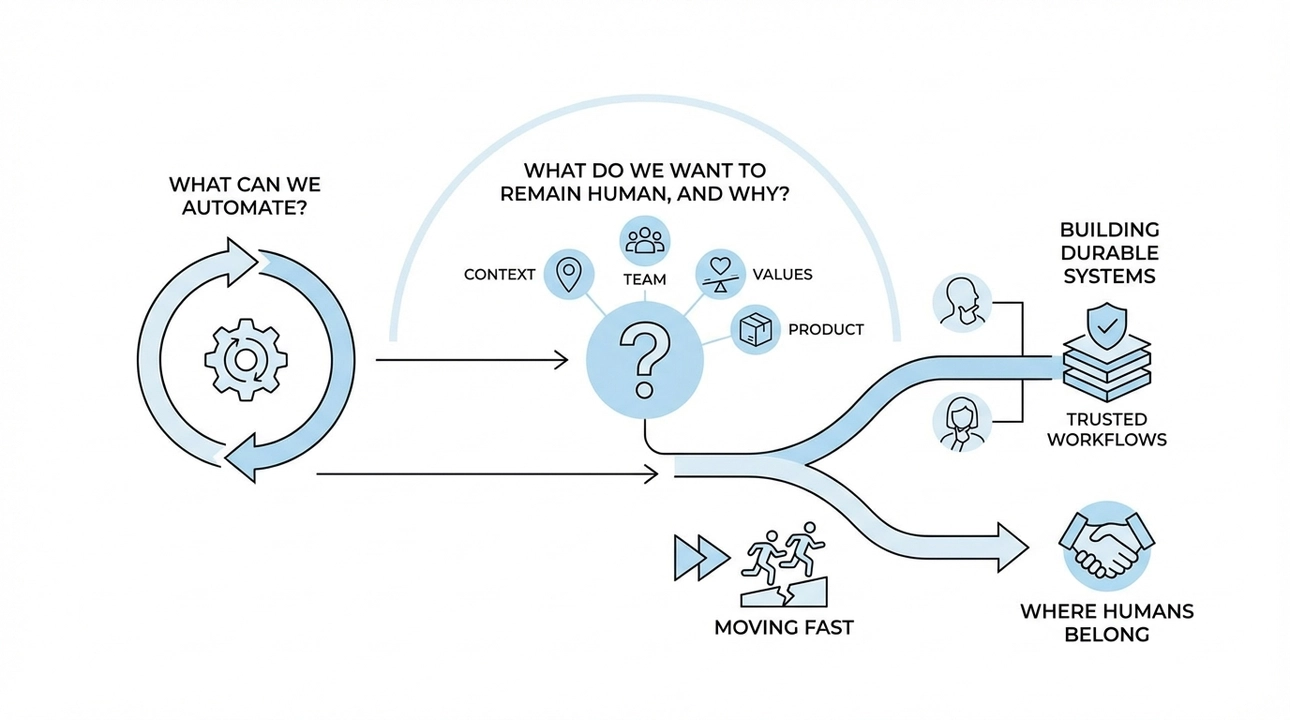
But asking it is what separates organizations that are genuinely building something durable from those that are just moving fast. Agents are not going to slow down. The capabilities are expanding faster than most teams are building intuition for them. Which means the founders, product leaders, and technologists who are thinking clearly about where humans belong in agentic workflows are the ones who will build the systems worth trusting.
The infrastructure is being laid right now, mostly by people who are not thinking of it as infrastructure. That is both the opportunity and the responsibility of this moment.