Why Building Bono AI Taught Me That Voice Is the Most Human Thing We Have Left

There is a moment in every product build where you stop asking "can we ship this?" and start asking "should it sound like this?" That question haunted me for most of the early days building Bono AI. I kept coming back to the same uncomfortable tension: we were building a voice AI meant to help people show up more authentically online, but every time the output felt too polished, too smooth, too perfectly structured, it felt less like the person and more like a press release. That gap between "generated content" and "genuine voice" is the whole problem. And honestly, figuring out how to close it is still the work.
The Part Nobody Warns You About
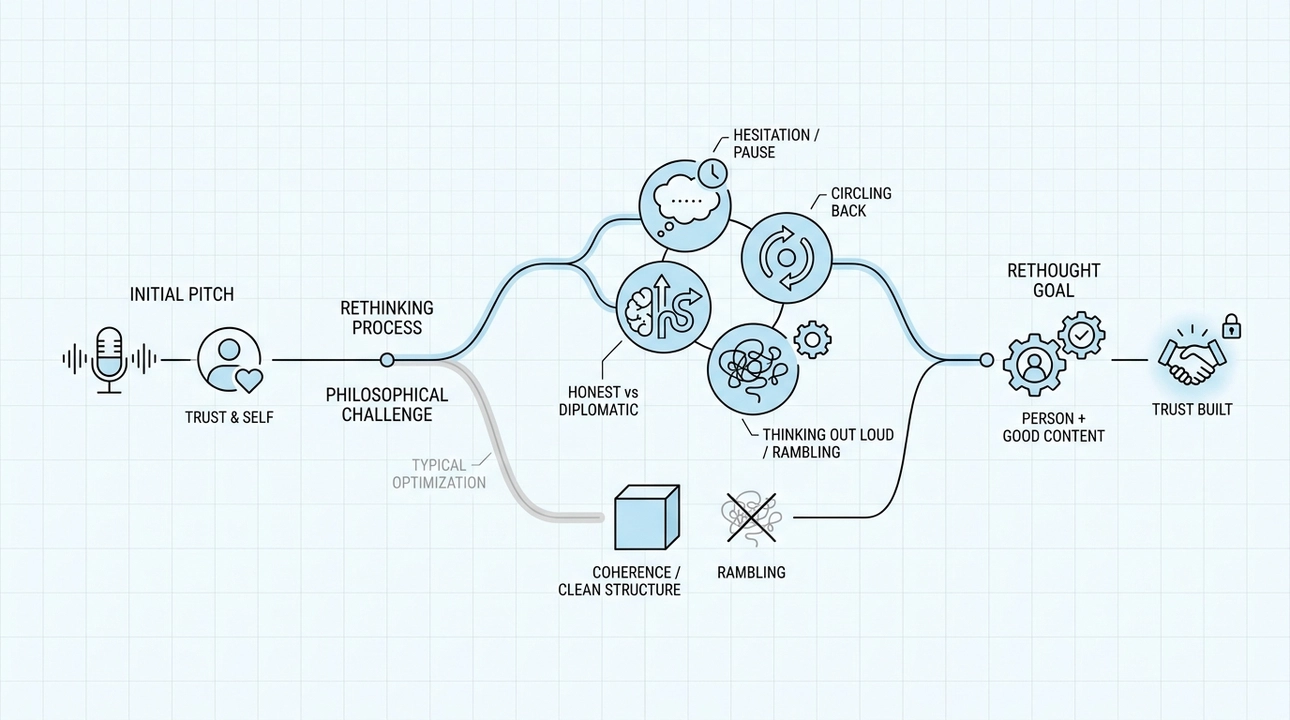
When I started building Bono AI, the pitch was clean in my head. Voice is intimate. People trust it. If you can capture how someone actually speaks and translate that into content that reflects their real thinking, you give them something most content tools never do: themselves, at scale.
Simple enough concept. Genuinely messy in practice.
The first challenge was not technical. It was philosophical. What does it actually mean for content to sound like you? Because your voice is not just word choice. It is the hesitation before a hard idea lands. It is the way you circle back to a point because you were not quite done with it. It is the three-second pause where you are deciding whether to say the honest thing or the diplomatic thing, and then usually saying both.
Most tools optimize for coherence. Clean sentences, solid structure, no rambling. But "no rambling" is exactly the wrong constraint when rambling is how someone thinks out loud, and thinking out loud is how trust gets built.
So we had to rethink what we were even building toward. Not content that sounds good. Content that sounds like the person, and still happens to be good.
What Voice AI Actually Has to Carry
The evolution of voice AI in the last few years has been real. Transcription is sharper. Synthesis is more natural. The latency problems that used to make voice interfaces feel clunky are shrinking. All of that is true, and none of it solves the core problem on its own.
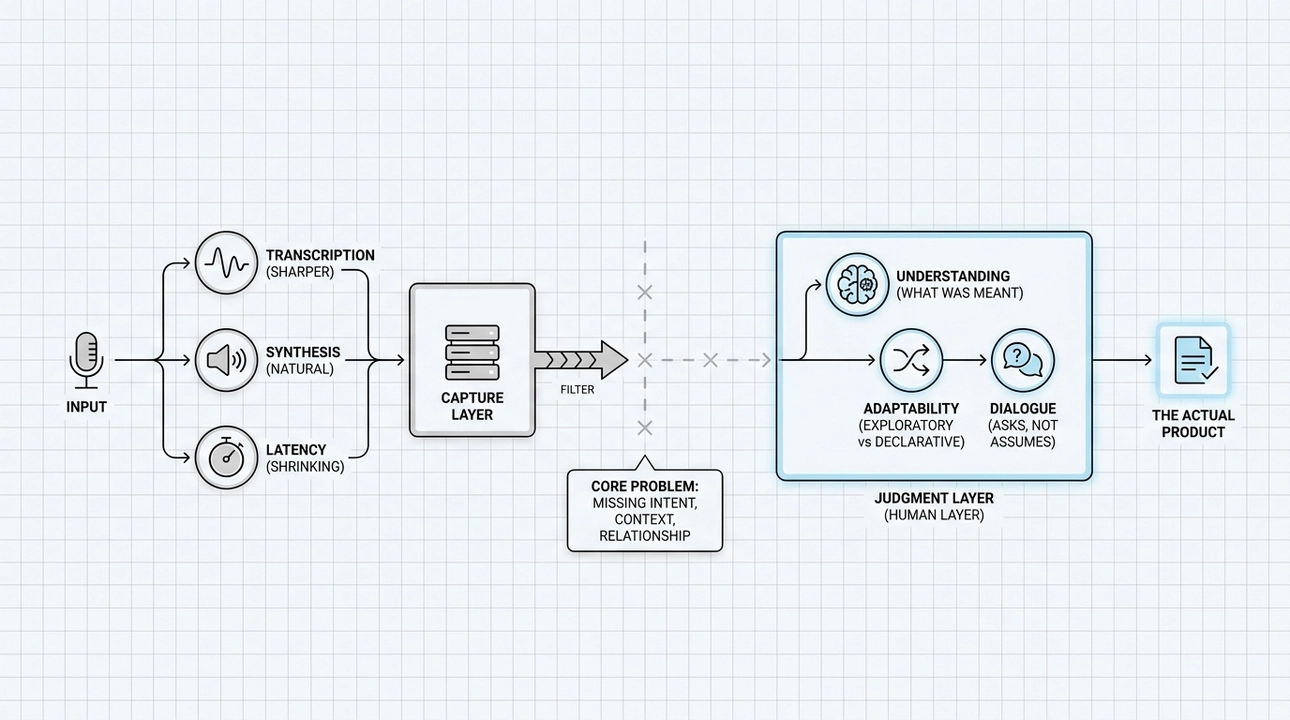
Here is what I kept running into: the technology gets you closer to capturing the words. It does not automatically capture the intent behind the words, or the relationship between the speaker and their audience, or the unspoken context that makes a point land.
That is where the human layer becomes non-negotiable, not as a fallback, but as the actual product. When someone records a voice note talking through an idea, a good system does not just transcribe it. It listens for what they were trying to say, not just what they said. It recognizes the difference between a speaker who is exploratory and one who is declarative. It knows when to preserve the rough edges and when to smooth them out, and it asks, not assumes.
That is the design challenge I find genuinely interesting. Building the judgment layer. Not just the capture layer.
Authenticity Is Not a Feature You Toggle On
One thing building Bono AI has reinforced for me is that authenticity in communication cannot be bolted on after the fact. It has to be the starting point.

A lot of personal branding tools treat authenticity like a finish. You produce the content, you make it "feel personal," and then you publish. But that order is backwards. If the raw input is not genuinely the person, no amount of post-processing makes it theirs.
This is why I keep coming back to voice as the entry point. Not because voice AI is a clever gimmick, but because when someone speaks, they reveal things they would never type. The reasoning is less guarded. The personality is harder to suppress. The actual thinking comes through. That is the material worth working with.
The job is not to make AI sound human. The job is to make sure the human comes through, and that the AI serves that goal rather than replacing it.
What I Think Is Coming
Personal branding has always rewarded the people willing to show up consistently and specifically. What changes with voice AI is not who wins that game. What changes is the cost of playing it. The people who used to struggle to write, who had great ideas but the blank page was the blocker, now have a different path in.
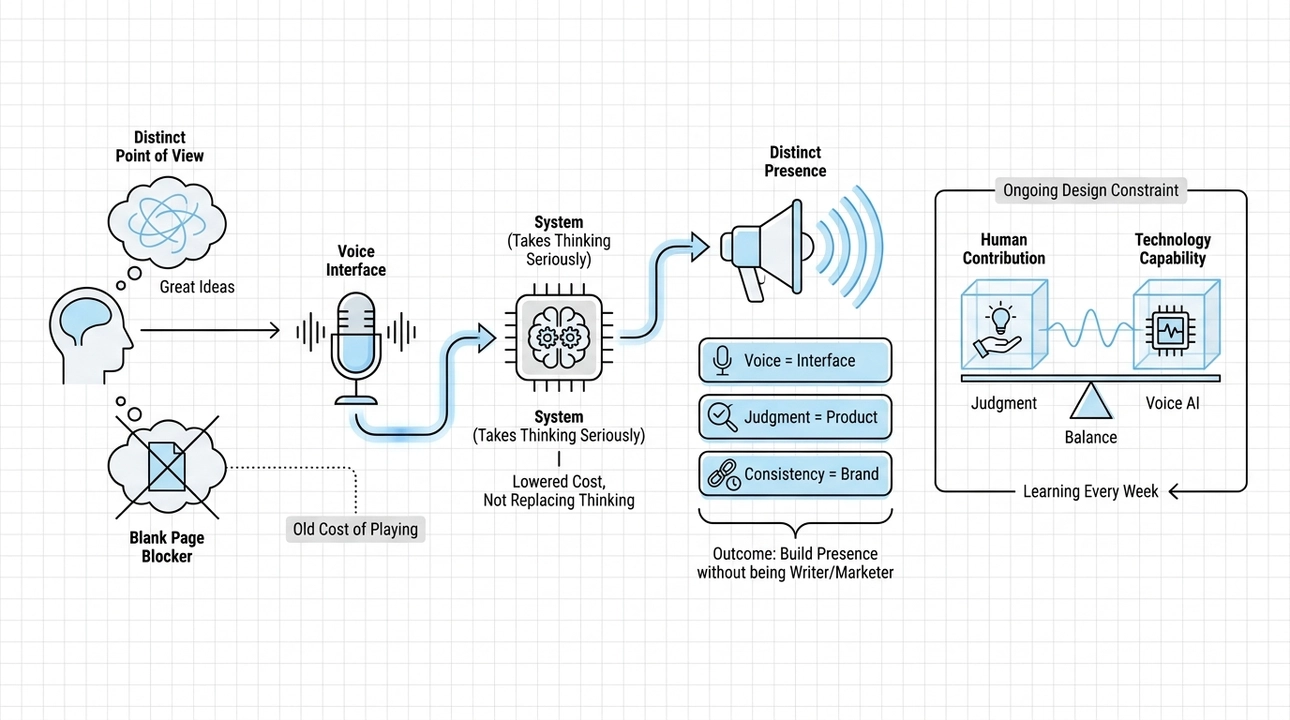
That is the version of this technology I want to build toward. Not a ghostwriter who replaces your thinking, but a system that takes your thinking seriously enough to get out of the way and let it land.
The future I am working on is one where anyone with a distinct point of view can build a distinct presence, without having to become a writer or a marketer first. Voice is the interface. Judgment is the product. Consistency is the brand.
That balance, between what the technology can do and what the human has to bring, is not a problem to solve once and move on from. It is the design constraint you live inside. I am learning that every week. And honestly, I think that is exactly where the interesting work is.