Why technical leaders struggle to build a personal brand and the AI companion that can fix the gap

The internet rewards volume, charisma, and constant visibility. Yet many of the most valuable builders in AI and product have never been trained to operate in an attention economy. They can ship complex systems, lead teams, and defend roadmap decisions with rigor, but freeze when asked a simpler question: what do you stand for, and who is this for?
That tension is becoming a quiet tax on technical leadership. Not because expertise is missing, but because translation is. The distance between knowing something and communicating it has never been wider, especially as AI accelerates the pace of work and compresses the time available for reflection.
For product and engineering leaders, founders, and architects, personal brand is not a vanity project. It is a delivery mechanism for ideas. It influences hiring, fundraising, partnerships, and trust. And it is often the most under designed part of an otherwise well designed career.
The hidden mismatch: builders are optimized for truth, platforms are optimized for performance
Technical careers reward precision. The best product minds learn to reduce ambiguity, separate signal from noise, and make decisions that can be justified. In that world, communication is a tool for alignment.
Public communication is different. It is not judged primarily on correctness. It is judged on resonance. The platforms prioritize clarity, emotion, and repetition. People do not follow someone because they are right. They follow because they are consistently useful, understandable, and specific.
This creates a mismatch that is easy to misread as a confidence issue. It is rarely about confidence. It is usually about operating systems.
A builder’s operating system says:
- Speak when the data is complete
- Avoid overclaiming
- Keep the message tight and defensible
- Let the work speak for itself
The platform operating system says:
- Speak while the ideas are forming
- Repeat the message in many shapes
- Tell stories, not just conclusions
- Put a recognizable human at the center
For someone coming from product and tech, the second operating system can feel like sales and marketing. And when the identity is builder, not salesperson, it can feel inauthentic. That is the core friction.
The real problem is not content creation. It is content discovery
Most advice about personal branding starts at the wrong layer. It starts with formats: post more, record more, be on video, create a newsletter, repurpose content.
Formats are downstream. Before the format, there is a harder question: what is worth saying, consistently, in a way that is uniquely owned?
In the transcript, the struggle surfaces in a set of deceptively simple prompts:
- What am I good at?
- What should I talk about?
- Who should hear it?
- What are the goals?
- What is the audience?
This is discovery work, not posting work. It resembles product discovery more than marketing.
Technical leaders often hold a lot of value in unstructured form:
- Strong opinions that have never been named as opinions
- Decision frameworks used internally but never externalized
- Lessons learned that feel too obvious to mention
- Mental models that are clear in practice but hard to explain on demand
That last point matters. Many builders think in systems, not soundbites. They may also rely on context to retrieve memories. So when asked to tell a story or craft a viewpoint, the mind offers facts and fragments, not narrative.
The result is a familiar loop:
- An idea appears while working
- It feels important but hard to package
- The moment passes
- The backlog grows, along with the frustration
The issue is not a lack of ideas. It is a lack of extraction.
Charisma is not the bottleneck. Clarity and cadence are
The attention economy has convinced many technical founders that visibility requires charisma, especially on video. But charisma is often a proxy measure for something else: clarity under constraints.
A founder can pitch and present in a company context because the container is known:
- There is a product
- There is a narrative arc
- There is a clear audience
- There is a purpose for the presentation
Personal brand content lacks that container. There is no default deck, no obvious arc, no single call to action. So the brain interprets the task as risky. It is easier to stay factual and logical, because facts feel safe.
This is why many product and tech leaders perform well in structured settings and feel uncomfortable in open ended public spaces. The discomfort is a design problem.
What helps more than charisma is cadence. A repeatable system for turning real work into clear artifacts.
That system can look like this:
1. Capture raw material during the week, not after it
2. Use consistent lenses to interpret the raw material
3. Publish in small units with a recognizable structure
4. Let repetition build familiarity and trust
None of that requires being a natural performer. It requires an intentional pipeline.
The missing role: a companion that interviews the expertise out of experts
The most revealing idea in the conversation is not about content at all. It is about needing a strategic partner.
Not a copywriter who produces posts.
Not a social media manager who schedules updates.
A companion that can interview, extract, and shape thinking.
This points to a new category of support for technical leaders: a content co pilot that behaves like a discovery partner.
The job of this companion is to help with three tasks that builders rarely have time to do alone.
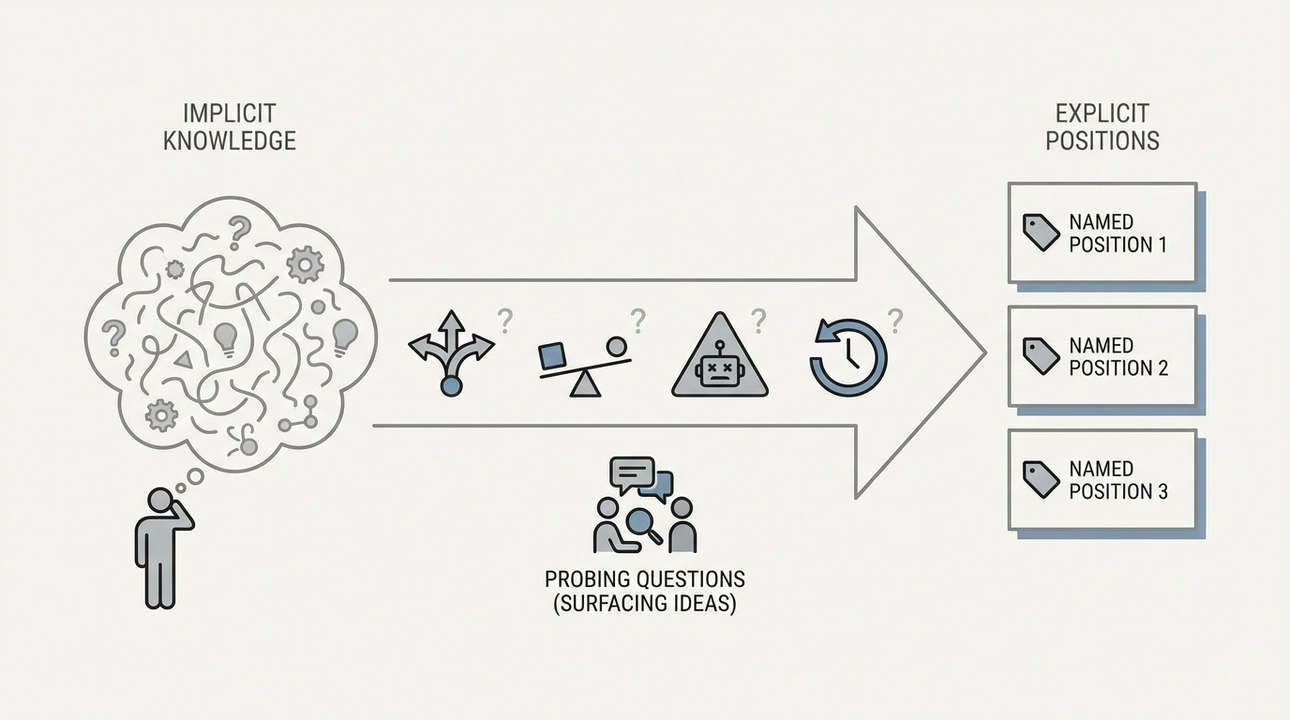
Task one: turn implicit knowledge into explicit positions
Most experts carry their strongest ideas implicitly. They show up as instincts in meetings, quick judgments during tradeoffs, or a strong sense of what not to do.
A companion can surface those ideas by asking questions that force specificity:
- What decision did the team make this week that others might disagree with?
- What tradeoff was accepted, and why?
- What is a common AI product mistake that keeps repeating?
- What would be done differently if starting again?
The goal is not to produce hot takes. It is to create named positions that can be revisited and refined.
Task two: build a set of lenses that make content predictable
The hardest part of publishing consistently is the blank page. A companion reduces blank page time by creating lenses that act like prompts tied to real work.
Examples of lenses that fit product and AI leadership:
- Decision lens: why a certain choice is optimal under constraints
- User lens: what people actually do versus what they say
- Systems lens: how small changes ripple through a product
- Execution lens: what makes shipping hard in practice
- Integrity lens: what should remain human even in AI driven workflows
With lenses like these, almost any week can generate content without forcing a personal performance.
Task three: convert speech into publishable narrative without losing precision
Many technical leaders communicate best by talking. The friction is turning talk into a coherent point of view.
A companion can act as an interviewer, then apply structure:
- Context: what situation triggered the lesson
- Tension: what made the decision non obvious
- Principle: the rule that emerged
- Application: how to use it next week
This structure respects factual thinkers. It does not demand theatrics. It produces clarity.

A practical brand architecture for technical leaders who do not want to become creators
A cohesive brand does not require constant reinvention. It requires a small set of consistent promises that match real strengths.
A useful way to design that architecture is to treat it like a product.
Define the product: the outcome the audience gets
Instead of starting with topics, start with outcomes.
For a product and AI leader, outcomes might sound like:
- Better decisions under uncertainty
- Clearer thinking about AI product tradeoffs
- Practical frameworks for building, not just theorizing
- Guidance on staying human while adopting AI
When the outcome is defined, topic selection becomes easier.
Define the ICP: not everyone who likes AI, but the people with the same constraints
Many experts accidentally aim at the broadest audience. That creates generic content. Strong brands aim at people who share constraints.
Constraints might include:
- Building in product and tech, not sales led roles
- Shipping with limited resources
- Managing ambiguity and stakeholder pressure
- Wanting authenticity without performative marketing
When constraints match, content feels personal even when it is not about personal life.
Define the message: three pillars that can carry years of work
A durable brand usually has three pillars. Not ten.
A sample set that fits the transcript themes:
- Building AI products with rigor and human judgment
- Translating complex technical decisions into clear narratives
- Creating systems for consistent thinking and communication
The specific pillars should be chosen based on where real credibility already exists and where energy remains sustainable.
Define the distribution: choose the minimum viable visibility
The pressure to be on video is real, but it is not mandatory. Different channels reward different strengths.
Options that work well for factual, logical communicators:
- Written posts that explain a decision or framework
- Short threads that break down a concept in steps
- Newsletter style essays that synthesize a month of learning
Video can come later, if desired. The key is to stop treating visibility as a single format problem.
What this means in the age of AI: the advantage shifts to those who can articulate judgment
AI tools are making production cheaper. Writing, design, and editing are increasingly commoditized.
As production becomes abundant, the scarce input becomes judgment:
- Knowing what matters
- Knowing what to ignore
- Knowing how to decide when the data is incomplete
- Knowing where humans must remain in the loop
This is exactly what experienced product and AI leaders have, but often do not package.
A companion that helps extract and articulate that judgment is not a productivity tool. It is an identity tool. It helps ensure that expertise does not stay trapped inside execution.
The quieter win: personal brand as a reflection practice, not a performance
There is a deeper point underneath the branding challenge. The desire for an assistant that can run a discovery session is a desire for structured reflection.
Reflection is not soft. It is how strategy is formed.
When a leader cannot remember their own insights later, it is not a character flaw. It is a symptom of working at high speed without a capture system.
In that sense, publishing can become a lightweight reflection loop:
- Work generates raw experience
- Reflection turns experience into a principle
- Publishing turns principle into an artifact
- The artifact attracts better conversations
- Those conversations improve the work
That is a compounding cycle. And it aligns with how builders already think: iterate, ship, learn.
Closing note: the future belongs to translators, not loudspeakers
The next wave of technical leadership will not be defined by who posts the most. It will be defined by who can translate complex work into clear, trustworthy perspective.
The strongest signal in a noisy market is not volume. It is coherence. A consistent set of lenses, applied to real decisions, expressed with precision.
That is what a well designed companion can unlock: not manufactured charisma, but extracted clarity. And in an era where AI can generate endless content, clarity remains one of the few things that cannot be faked for long.
The work behind the work
A personal brand is often described as visibility. A more accurate description is legibility.
When expertise becomes legible to others, opportunities follow naturally: the right collaborators, the right customers, the right problems.
The goal is not to become a creator. The goal is to make real thinking easier to find, easier to trust, and easier to build on.