Voice Agents with Proprietary Data Access, Contextual Memory, and Real-Time Actions

Everyone is shipping voice. Claude has it. ChatGPT has it. Gemini has it. And in the past year, voice has gone from a novelty add-on sitting on top of a chat interface to something that actually tries to hold a two-way conversation. That is real progress. I am not dismissing it.
But I want to be honest about what most of it actually is: a horizontal layer dropped onto a general-purpose model. It can talk, it can listen, and it can answer questions. What it cannot do, in most cases, is reach outside of its own training data in any meaningful way, take real action on your behalf, or know anything specific about you beyond what you told it five minutes ago. That gap, between a voice interface and an actual voice agent, is where I spend most of my time thinking.
The Wall Every Vertical Agent Hits
There is a wave of startups building verticalized agents right now, and I think most of them are doing the right thing in principle. Narrow scope, deep domain knowledge, trained on specific workflows. That is the right instinct. The problem is that most of these agents are still bounded by their own internal dataset. They know what is inside the walls. They cannot look over them.
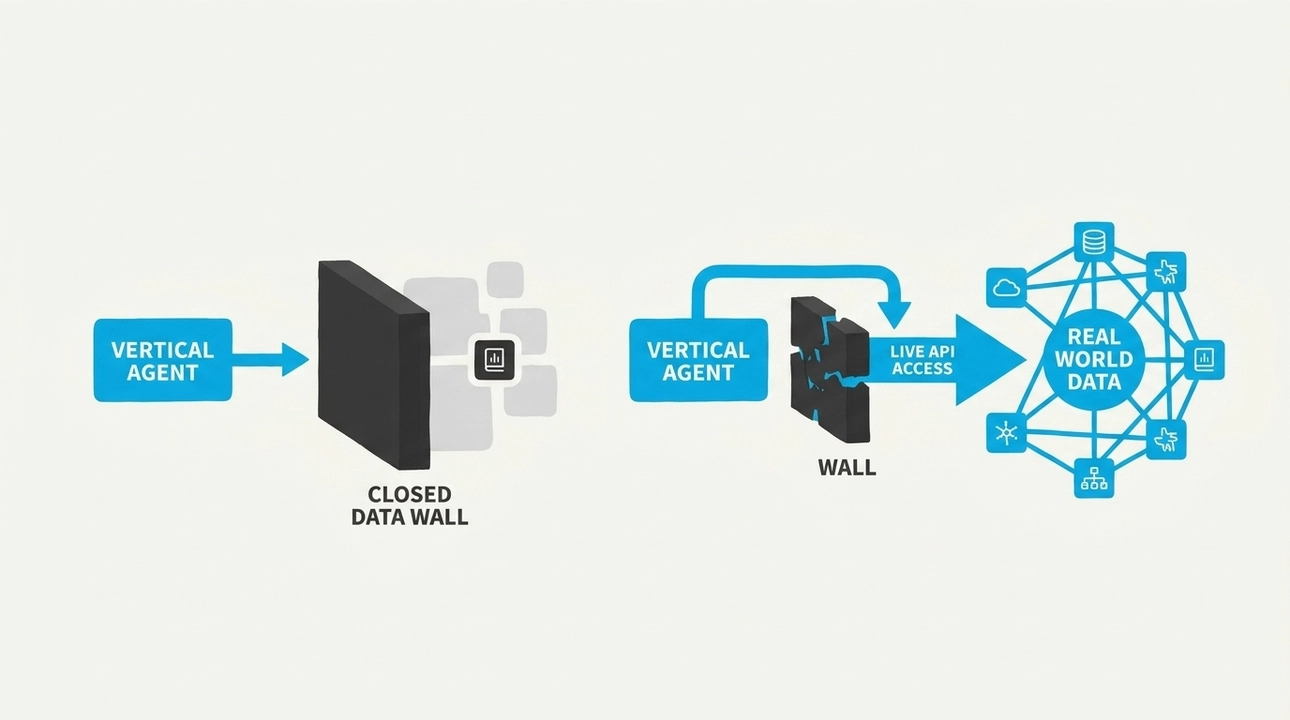
That limitation is significant. If your agent can only reason about what you have already given it, then it is still just a fancy search interface over your own documents. Useful, but not transformative. The real unlock happens when you combine that specialized dataset with the ability to reach out, in real time, and pull in information from the world that is relevant but not already stored.
This is the distinction I keep coming back to: closed-network data versus live API access. I wrote about this in an earlier context around real-time actions, but the more I build with it, the more I believe it is the actual competitive fault line. An agent that can only work with what it has memorized is fundamentally different from one that can go get what it needs right now.
Most voice agents, even vertical ones, are on the wrong side of that line.
What We Are Actually Building With Bono
Bono started as a voice-first content platform, the idea being that you should be able to turn a conversation into published work without ever sitting down to write. That core idea has not changed. But the surface area of what the agent does has grown considerably.
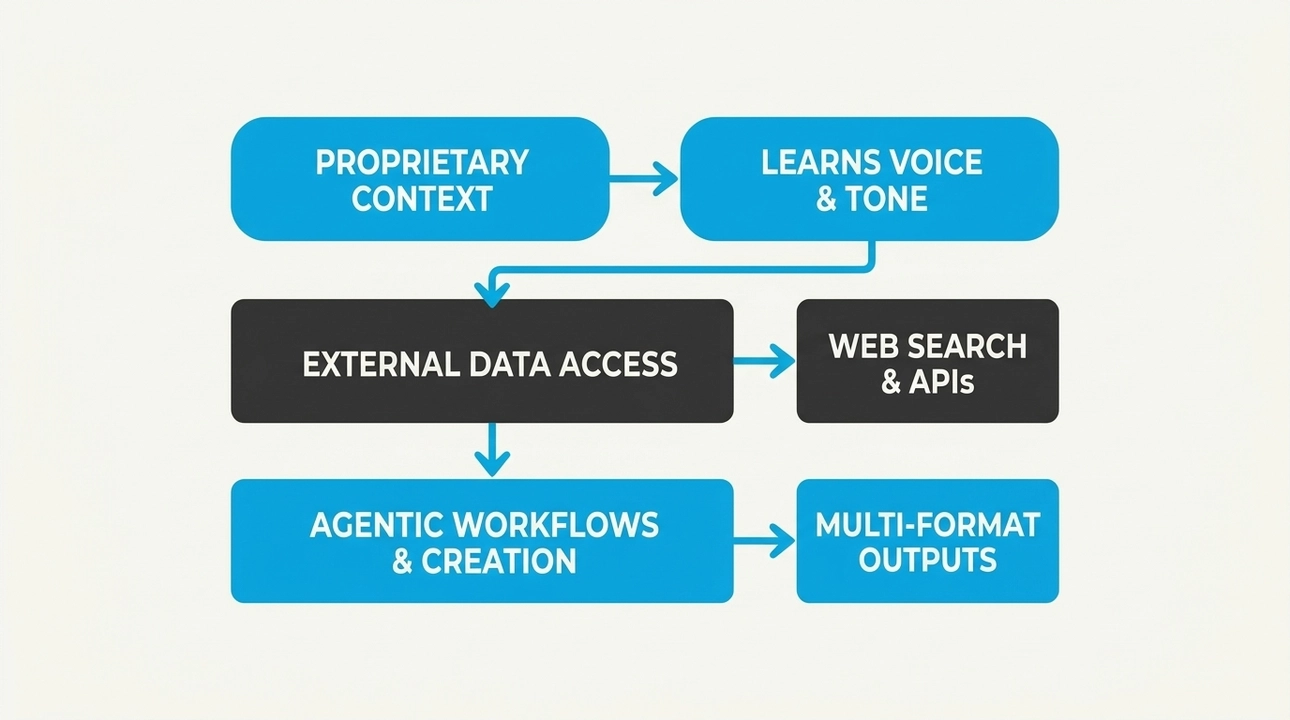
What we have now is something closer to what I would call an agentic operating system for marketing and go-to-market, which is a phrase I am still working out the exact name for, but it is the closest thing to what it actually does.
Here is what I mean. Bono has three layers working together that most agents only have one or two of.
The first is memory and proprietary context. Bono knows your voice, your tone, your style, your positioning, and the specifics of your business because we have built a context extraction mechanism that learns over time. This is not just a profile you fill out once. It is something that gets richer with every conversation, every skill added, every piece of knowledge it absorbs. The agent is not working from a blank slate each time.
The second is external data access. Beyond your own memory, Bono can reach out and pull in information that is relevant to what you are working on: competitive intelligence, research on people and organizations, publicly accessible signals that a general model would either not find or would only surface from stale training data. This is not just search. It is targeted retrieval that is scoped to what actually matters for your context. That combination of private memory plus real-time external access is where the real depth comes from.
The third is tooling and real-time actions. Bono has deep integrations with social platforms, not just the ability to draft content but to publish it, in multiple formats, on brand, timed appropriately. It has calendar integrations, SMS and email delivery for follow-ups, and a growing set of actions it can take without you needing to go open another app. These are not demo-level capabilities. They are production actions, things that actually ship on your behalf.
What makes this interesting is that none of these three layers works as well in isolation. Memory without action is just a better notes app. External data without memory lacks the context to make it relevant. Real-time actions without proprietary knowledge produce generic output. It is the combination that creates something that actually feels like leverage.
The Interface Is the Product
One thing I want to be clear about, because I think it gets underestimated: the phone call is not a gimmick. It is the actual design decision that makes everything else work.
Most AI products are still fundamentally tied to a screen. You open an app, type a prompt, read a response, tap a button. The interface assumes you are sitting down with attention to give. Bono is designed around the assumption that you are not. You are in the car, between meetings, walking, thinking. You call Bono, or Bono calls you, and you just talk.
That frictionless interface changes what people are willing to use the tool for. When the barrier to engaging is a phone call, you actually use it to think out loud, work through strategy, capture a fleeting idea before it disappears. The tool fits into your life rather than demanding you fit into it.
And now we have pushed that further. You can ask Bono to take specific actions and have outputs sent directly to you over SMS or email, so you do not have to go look for results. The information comes to you. We have also started building toward voice as a control layer for the application interface itself, where you can navigate and instruct the product through conversation rather than clicks. The accessibility implications alone are significant, but more than that, it is just a better way to work.
This is where the "operating system" framing starts to feel accurate to me. You are not just using a tool. You are directing a system that handles the downstream work, research, writing, publishing, competitive positioning, and you are doing it through the most natural interface humans have ever had: talking.
Why This Matters for How You Think About Go-to-Market
I built Bono out of our own experience running agencies, building marketing technology, and automating go-to-market workflows. That background shaped exactly what we decided to make the agent good at.
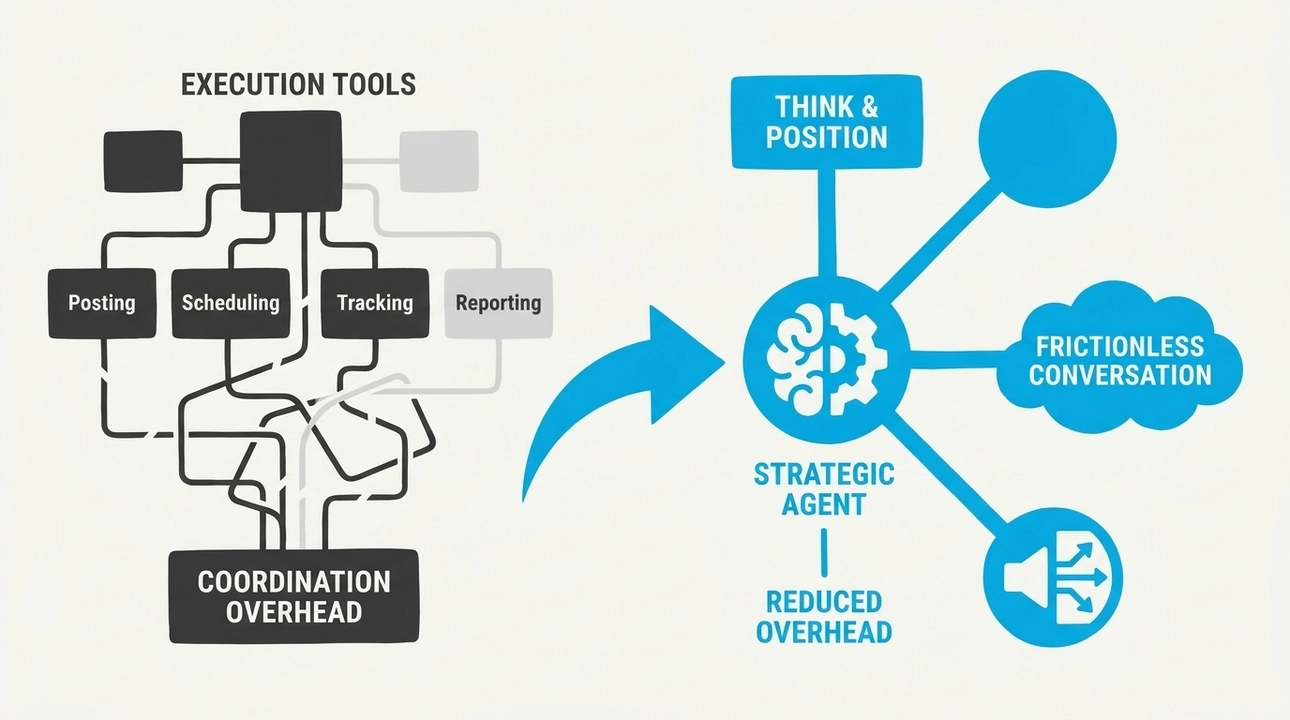
A lot of marketing tools help you execute. They help you post, schedule, track, report. Bono is trying to do something slightly different: help you think and position, not just execute. Because it has access to how you are showing up, how your competitors are showing up, and what the space looks like, it can help you understand not just what to publish but why, and where you actually have a differentiated angle.
That combination of strategic context and execution capability, all delivered through a conversational interface that requires almost no friction to use, is what I think makes the category interesting. You are not replacing a marketing team. You are replacing the coordination overhead that a marketing team requires. One agent, one conversation, and the output finds its way to where it needs to go.
The thing I keep telling people is that the frictionless part matters as much as the capable part. An agent that can do everything but requires you to manage it like a project still has a tax. When the interface is a phone call and the output lands in your inbox or publishes directly, you actually close the loop. That is where it gets sticky.
The vision has always been the same: give someone the equivalent of a full go-to-market function that lives inside a single, reliably accessible conversation. We are closer to that now than at any other point in building this. And the infrastructure layer, the tooling, the APIs, the memory, is finally catching up to what that vision actually requires.